
Utility pumps vary based on whether you need to drain a small puddle or handle thick debris in a flooded basement. These picks stand out based on their motor power, discharge options, and how much water they leave behind. You are selecting between specialized tools for tight spaces and high-flow machines for larger jobs.
As an Amazon Associate, we earn from qualifying purchases. This post contains affiliate links – if you buy through them, we may earn a commission at no extra cost to you.
Best overall: WAYNE WaterBUG, because its Multi-Flo technology allows you to switch between top and side discharge depending on the surface you’re clearing. Most reliable performance: Superior Pump 91250, because it is 100% factory tested and built with a tough thermoplastic housing designed for longevity. Best for heavy debris: Tsurumi HS2.4S, because it features an integrated agitator that helps it handle sand and solids without clogging.
This guide is for homeowners looking for clear, honest information to help them select a utility pump that matches their specific drainage needs.
How We Picked
We compared 48 different Amazon listings to find the most capable utility pumps on the market. To earn a spot, each product had to clearly state its flow rate, discharge size, and any included adapters for hose connections. We excluded models that lacked clear specifications regarding their maximum lift height or solid-handling capabilities. Our goal was to provide a list where the trade-offs—such as manual versus automatic operation—are easy to spot so you can make an informed choice.
1. WAYNE WaterBUG Submersible Water Pump

Best for: Homeowners needing versatile water removal in tight spaces.
The WAYNE WaterBUG offers a unique design with Multi-Flo technology. You can switch between top and side discharge, which makes it easy to use in window wells or across flat surfaces. It pumps up to 1350 GPH and can remove water down to 1/16 inch.
Because it lacks an automatic shut-off, you must unplug it once the water is gone to prevent it from running dry. This makes it a better choice for someone who prefers to supervise the entire pumping process. It isn’t for users who need a “set it and forget it” solution for long-term basement flooding.
Pros
- Versatile top and side discharge options
- Removes water down to 1/16 inch
- Non-corrodible plastic discharge outlets
Cons
- No automatic start/stop function
- Must be unplugged to prevent dry running
2. Superior Pump 91250 1800GPH Thermoplastic Submersible Utility Pump with 10-Foot

Best for: Reliable, high-capacity water movement on flat surfaces.
This pump moves up to 1,800 gallons per hour, making it a strong contender for clearing standing water. Its thermoplastic construction is built to last, and it handles solids up to 1/8 inch. It includes a 10-foot cord and a 3/4 inch garden hose adapter.
The 1-1/4 inch NPT discharge provides high capacity, but you must match your hose size to this port to achieve the maximum flow rate.
This model is designed for utility and high-volume transfer rather than precision drying. It isn’t for people who need to remove water to a near-zero depth, as the suction screen requires a certain water level to operate without airlocking.
Pros
- Moves up to 1,800 GPH
- Tough thermoplastic construction
- Handles 1/8 inch solids
Cons
- Not designed for ultra-shallow water
- Requires manual monitoring
3. Little Giant 5-MSP 115-Volt

Best for: Industrial-grade durability in a compact size.
Built with epoxy-coated die-cast aluminum, this pump is designed for serious, long-term use. It features a permanently lubricated 1/6 HP motor with thermal overload protection, which adds a layer of safety during heavy-duty tasks. It weighs 7.75 lbs and is easy to carry via the built-in handle.
Since this is a manual pump, you have full control over when it runs. Use it when you need to transfer or recirculate liquid in commercial, industrial, or home settings. If you require a unit that starts automatically when water levels rise, look elsewhere; this model requires you to be present to plug it in and monitor the flow.
The pump includes a 1-inch FNPT discharge and a 3/4-inch garden hose adapter. It delivers 1200 GPH at 5.0 running Amps.
4. AQUASTRONG 1 HP Sump Pump 4500 GPH Submersible Water Pump
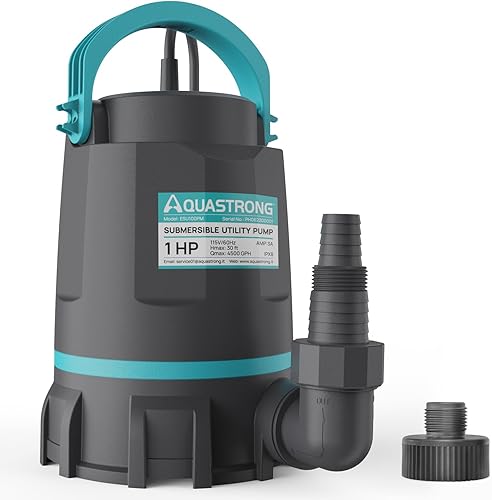
Best for: Moving large volumes of water quickly.
With a 1 HP motor, this pump delivers an impressive 4500 GPH, or 75 gallons per minute, when working at a 5-foot lift. It’s designed to push water up to 30 feet of vertical height, making it a reliable choice for deep basement flooding or clearing low-lying window wells.
The bottom suction design clears water down to 1/5 inch from the surface. If you’re dealing with debris, the unit handles solids up to 1/5 inch in diameter. Use the included 1-1/4 inch NPT discharge with the provided adapters for 3/4, 1, or 1-1/4 inch hoses to match your existing setup.
This pump is powerful, so it may be overkill for minor, occasional puddles. If you need a quiet, low-flow pump for delicate tasks like aquarium maintenance, look elsewhere. The built-in thermal overload protector prevents the motor from burning out during dry running, but always ensure your hose diameter is sufficient to handle the high volume to avoid backpressure.
Pros
- High 4500 GPH flow rate
- 30-foot maximum lift height
- Multiple adapters included
Cons
- May be too powerful for small jobs
- Requires careful hose selection for high flow
5. FOTING 1/2HP Submersible Water Pump with Stainless Steel Base

Best for: Shallow water removal in basements or pools.
This pump is excellent for shallow water, as it can remove liquid down to 0.04 inches. The stainless steel filter handles solids up to 1/5 inch, and the unit is lightweight at 8.5 lbs. It comes with three different adapters for hose flexibility.
Before you start, tilt and submerge the pump for a few seconds. This expels trapped air and prevents freezing in cold winter conditions.
Pros
- Clears water to 0.04 inch depth
- Stainless steel filter included
- Three years of after-sales service
Cons
- Manual operation only
- No automatic start/stop
6. Green Expert 1/3HP Submersible Sump Pump with Water Sensor Switch

Best for: Automatic water removal with minimal effort.
This pump offers both manual and automatic modes, thanks to its built-in water sensor. It can drain water down to 1/25 inch and stops automatically 15 seconds after it detects no more water. It’s a great choice for flooded garages or basements.
The sensor works best on rigid, flat surfaces. It isn’t for people using soft pool covers, as the sensor may be blocked unless you use a raised filter. If you’re pumping low-conductivity water, such as distilled or condensation, you must switch to manual mode and monitor the unit closely to prevent damage.
Avoid using expandable or retractable hoses with this system. These types of hoses often restrict flow, which prevents the 1/3HP motor from reaching its maximum capacity of 2000 gallons per hour.
Pros
- Automatic sensor for convenience
- Drains to 1/25 inch
- Versatile manual and automatic modes
Cons
- Sensor needs flat, rigid surfaces
- Not ideal for soft pool covers
- Incompatible with expandable hoses
7. Acquaer Utility Water Transfer Pump 1/10 HP Portable Electric

Best for: Tight, hard-to-reach areas like water beds or aquariums.
This is a non-submersible, self-priming pump designed for clean water transfer. It features a metal volute for durability and includes a 6-foot suction hose. Use this model when you need to move water from a container or a shallow flooded area, rather than dropping a unit into deep standing water.
Because it isn’t submersible, you must fill the pump head with water to wet the impeller before starting. If you run the motor dry, you risk significant damage. If you’re draining a rain barrel or a water heater, keep the pump unit itself dry and outside of the water source.
Pros
- Self-priming for easy setup
- Durable metal volute construction
- Includes a complete suction kit
Cons
- Not for submersible use
- Requires manual priming before every use
- Motor must remain dry at all times
This pump delivers 264 gallons per hour and reaches a maximum lift height of 46 feet.
8. Tsurumi Pump HS2.4S Submersible Trash Pump with Agitator 1/2 HP

Best for: Construction sites or areas with sand and grit.
The Tsurumi HS2.4S is a professional-grade trash pump. It features a semi-vortex impeller and an agitator to handle solids up to 0.3 inches, preventing clogs in dirty water. It’s built to last and comes with a 20-foot cord.
This is a rugged tool, not a light-duty household pump. If you’re clearing clean, shallow water from a basement floor, this unit is overkill. Use it instead for disaster remediation or construction sites where the water contains heavy sand and debris. The 1/2 horsepower motor and 39 GPM flow rate are designed specifically for these high-wear environments.
If you encounter frequent clogs in your current setup, the agitator is the feature that separates this pump from standard models. It keeps solids suspended, allowing the 2-inch discharge port to move debris without stopping.
Pros
- Agitator handles sand and solids
- 0.3 inch solids handling
- 20-foot power cord
Cons
- Heavy-duty, not for delicate tasks
- Overkill for clean water
9. DEWALT� 1/3 HP Rugged Cast Aluminum

Best for heavy-duty dewatering where high lift is required. This pump arrives as a complete kit, featuring 25 feet of industrial-strength hose and quick-connect cam-lock fittings. Its cast aluminum body provides the durability needed for demanding environments.
The unit moves water at 60 gallons per minute at zero lift, dropping to 50 gallons per minute at a 10-foot vertical rise. If your project requires clearing water from deep areas, this pump handles a maximum lift of 35 feet.
Avoid this model if you only manage small, indoor spills. It’s built for high-volume tasks, not delicate household cleanup. The bottom suction design and vortex impeller allow it to clear water down to 3/8 of an inch. It also passes solids up to 3/8 of an inch to prevent clogging.
Use this tool when you need reliable, on-demand removal for serious water projects.
10. WAYNE TSC130 Submersible Utility Pump

Best for: Stable, long-lasting performance in indoor spaces.
The WAYNE TSC130 is a reliable 1/6 HP pump that removes water down to 1/16 inch. Its top-center discharge design ensures balanced installation and stable placement while it works. It’s a solid, no-nonsense choice for basement maintenance.
Like many utility pumps, it’s manual and requires you to unplug it once the water is cleared. If you need a system that handles the job without supervision, this model isn’t for you. You must remain present to prevent the motor from running dry once the water level drops.
The unit features a heavy-duty brass discharge outlet designed for direct compatibility with standard garden hoses. Use this for quick, easy connections to standard hoses. While it delivers up to 25 feet of lift, ensure your application remains indoors.
Pros
- Stable top-center discharge design
- Capable of draining surfaces until they are nearly dry.
- Assembled in the USA
Cons
- Manual operation only
- Limited to 1/6 HP power
How to Choose in Sixty Seconds
Which type of pump do I actually need?
Choose based on the water’s state. If the water is clean and on a flat floor, a submersible pump like the WAYNE WaterBUG is ideal. For transferring liquid from a tank or waterbed, a non-submersible transfer pump like the Acquaer 1/10 HP is the right tool. Always confirm the “solids handling” rating to ensure the pump can manage the specific type of debris you expect to encounter.
Does the discharge size really matter?
Yes, the discharge size dictates how much water can move through the hose at once. A larger discharge, such as 1-1/4 inch, is better for high-volume drainage, like a flooded basement. Smaller discharge ports are standard for garden hoses and are sufficient for small, slow-moving water removal tasks. When installing, ensure your hose matches the pump’s outlet to avoid flow restrictions. Manufacturers provide guidelines on installation to help you choose the correct hose and prevent accidental damage to the motor during operation.
Should I pay more for an automatic pump?
Automatic pumps are better if you can’t monitor the pump constantly. They use sensors to start and stop, preventing the motor from running dry, which can damage the internals. If you’re comfortable staying nearby to unplug the unit once the water level drops, a manual pump is often a more durable and simpler option with fewer parts that can fail. If you choose an automatic model, ensure it’s rated for the specific type of floor you have, as some sensors struggle on uneven or flexible surfaces.
The WAYNE WaterBUG remains our top choice for most homeowners due to its versatile discharge options, while the Superior Pump 91250 is an excellent alternative if you prioritize raw reliability and factory-tested performance. Before ordering, verify if your drainage area requires a specific solids-handling capacity or an automatic sensor. Once you receive your pump, keep the user manual in a safe place, as it contains the specific priming instructions for your model. Following these steps will ensure your pump is ready when the next heavy rain arrives.
Related guides
- Top 10 Best Showerheads for Low Water Pressure in 2026
- 10 Best Bike Tire Pump Picks for Reliable Inflation in 2026
- Best Water Saving Showerheads: 10 Top Picks for Efficiency in 2026
Frequently Asked Questions
What does it mean when a pump is “not for dry running”?
Pumps not rated for dry running will overheat and fail if operated without water. Water acts as a vital lubricant and coolant for internal seals and motor components. Always monitor the pump and unplug it immediately once the water reaches the manufacturer’s minimum suction depth.
How do I clear a clogged suction screen?
If your utility pump flow slows, the suction screen is likely blocked by debris. Unplug the unit, remove it from the water, and wipe away any leaves or sediment from the intake area. Check the screen frequently when working in dirty environments to maintain peak performance.
Is the simplest pump on the list enough for me?
A simpler pump is often enough if your needs are occasional and involve clean water. The WAYNE TSC130, for example, is a straightforward, reliable pump for basement maintenance without the complexity of sensors or agitators. Focus on the horsepower and lift height rather than extra features you won’t use.
What maintenance does a utility pump require after use?
Flush your pump with clean water after each use to prevent mud and debris from hardening inside. Inspect the impeller occasionally for wear or obstructions to ensure consistent operation. Store the unit in a dry place to prevent corrosion and extend its overall service life.
Conclusion
Once you’ve selected your model, keep it stored in a dry, accessible spot so you’re ready when the next heavy rain arrives. It’s a good idea to test the unit once a season to ensure it’s running smoothly. You’ll feel much more confident knowing you’ve got the right backup for any emergency.