
Choosing the right heating cable depends on where you live and what kind of pipes you have. You’re picking between simple, pre-assembled cables for quick fixes and advanced, self-regulating systems for long-term protection. The main differences are how they handle temperature changes and whether they’re meant for permanent or temporary use.
As an Amazon Associate, we earn from qualifying purchases. This post contains affiliate links – if you buy through them, we may earn a commission at no extra cost to you.
Best overall: Frost King HC6A is the most straightforward choice for standard residential metal or plastic pipes, offering reliable performance down to extreme temperatures with a simple, easy-to-install design.
Most reliable: EasyHeat 30′ Cable provides durable outdoor protection for roof edges and gutters, featuring a pre-assembled setup that requires no complex tools or specialized electrical wiring for installation.
Best self-regulating: VEVOR Self-Regulating Cable uses a built-in thermostat to automatically adjust heat levels based on pipe temperature, making it a highly efficient choice for preventing freezing in various outdoor water lines.
The rest of this guide is for homeowners looking to prevent burst pipes during harsh winters.
How We Picked
We compared 48 different Amazon listings to identify the most dependable heating cable options for residential use. To make our list, each product had to clearly state its technical specifications, including wattage per foot, compatible pipe materials, and the temperature threshold for activation. We focused on products that offer comprehensive safety certifications and clear installation requirements. Any product that failed to specify its intended use or lacked essential safety documentation was excluded from our final selection.
1. Frost King HC6A Automatic Electric Heat Kit Heating Cables
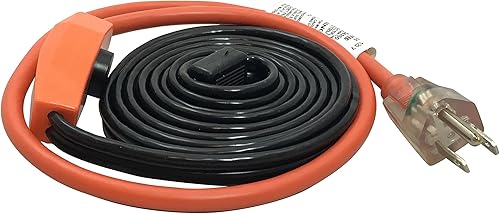
Best for: Homeowners needing a quick, simple pipe freeze solution.
This cable is designed for a straightforward, plug-and-play experience. It works with both metal and plastic pipes and is rated to keep water flowing even when temperatures drop to -40 degrees Fahrenheit. Because it comes in a fixed 6-foot length, it’s best suited for small sections of exposed pipe rather than long runs.
Installation is designed to be simple for those without professional plumbing or electrical experience. However, the fixed length means this product isn’t for users who need to cover long, complex pipe networks throughout an entire basement or outdoor system.
Pros
- Simple to install design.
- Works on metal pipes.
- Protects plastic water pipes.
Cons
- Fixed 6-foot length only.
2. EasyHeat 30′ Pipe Heating Cable

Best for: Protecting roofs and gutters from ice dams.
This cable is built for outdoor durability, making it a strong choice for preventing ice buildup on roof edges and in gutters. It comes fully assembled with a power cord and mounting hardware. You can start the installation process as soon as it arrives without needing special tools or extra wiring.
The 30-foot length offers enough coverage for most standard residential gutters or downspouts. If your roof line exceeds 30 feet, you must purchase additional units to ensure complete coverage, as overlapping cables or leaving gaps can lead to localized ice dams. It isn’t suitable for wrapping around small, interior plumbing fixtures where a shorter, more flexible cable is required.
Operating at 210 watts, this cable delivers 7 watts per foot. It is UL-listed for safety, ensuring reliable performance during harsh winter conditions.
Pros
- Pre-assembled for easy setup.
- Tough weather-resistant outer materials.
- Covers 30 feet of length.
Cons
- Not for interior plumbing.
3. VEVOR Self-Regulating Pipe Heating Cable

Best for: Users wanting automatic, energy-efficient temperature control.
This cable features a built-in thermostat that automatically turns on at 43 degrees Fahrenheit and shuts off at 55 degrees Fahrenheit. This self-regulating function saves energy because the cable only draws power when temperatures drop. If you notice the indicator light on the grounded plug is off, the system isn’t receiving power or has reached the safe temperature threshold.
The 18-foot length provides versatility for outdoor hydrants, valves, and faucets. It isn’t recommended for extremely long pipe runs, as the fixed 18-foot length is non-adjustable. If your pipe run exceeds this distance, don’t attempt to splice or shorten the cable, as this voids the CE-approved safety rating.
Pros
- Automatic thermostat saves energy.
- Rapid 5-minute heating time.
- IP68 waterproof rating included.
Cons
- Length can’t be adjusted.
- Limited to 18-foot spans.
4. HEATIT 24FT Water Pipe Heat Tape

Best for: Those who prioritize third-party safety certifications.
This cable stands out for its rigorous testing, as it’s both CSA and ETL certified from end to end. It’s designed specifically for water-filled pipes and uses 7W/ft to maintain temperatures in cold conditions. Always verify the entire unit is certified, as a plug-only rating doesn’t guarantee full system safety.
The installation requires a straight line. Never cross, spiral, or overlap the cable, as this causes dangerous overheating. If your pipe layout prevents a straight run, this product isn’t suitable for your needs.
Before mounting, test the unit by placing the thermostat in an ice bucket. It should activate when the temperature drops below 37°F. If the cable fails to warm up, don’t install it.
Pros
- Full CSA and ETL certification.
- Includes 2-year limited warranty.
- Grounded plug with indicator.
Cons
- Straight-line installation required.
- Prohibited for fuel lines or gutters.
5. Cupohus 30FT Self-Regulating Heat Tape

Best for: Users who want to monitor temperatures in real-time.
This cable includes a digital display thermostat that lets you see the current temperature of your pipe at a glance. It allows for adjustable heating ranges between 37.4°F and 59°F, giving you more control over exactly when the unit starts and stops.
The system is designed to be paired with a GFCI outlet for extra safety against electrical shorts. If you notice the cable failing to heat, verify the connection at your GFCI outlet first, as this is the most common point of failure for moisture-exposed setups. It isn’t for users who want a “set it and forget it” device without any digital interaction, as the display is a central part of its operation.
To verify the system is working, submerge the thermostat probe in ice water. If the cable fails to heat up after a few minutes, check the probe placement.
Pros
- Real-time digital temperature display.
- Adjustable temperature start/stop range.
- Includes 3-year warranty service.
Cons
- Requires GFCI power outlet.
6. HEATIT Mobile Home 100′ Heat Cable HTM Braid Self Regulating

Best for: Mobile home owners needing reliable freeze protection.
Designed specifically for the unique needs of mobile homes, this 100-foot cable provides a long-reach solution for metal or plastic water supply and drain pipes. It uses self-regulating technology to adjust heat output based on the ambient temperature at any given point along the line. This feature prevents overheating, which is a common failure point in fixed-wattage cables.
The cable is durable and features a tinned copper braid for grounding and protection. You must purchase the HEATIT HTM connection kit separately to complete the installation. If you skip this specific kit, the system won’t function as intended. Installers should use glass cloth tape and fiberglass insulation to ensure the heat stays where it’s needed.
Once finished, plug the unit into a 120V AC outlet and wait one hour before testing. If the water runs warm, the installation is successful.
Pros
- Long 100-foot reach.
- Self-regulating heat output.
- ETL approved for safety.
Cons
- Connection kit sold separately.
7. 13 ft DC 12V Self-Regulating Anti-Freeze Heat Cable

Best for: RV owners using 12V power systems.
This cable operates on a 12V DC power source, making it ideal for RVs and trucks that lack access to standard household outlets. It’s a self-regulating, pre-assembled unit designed to keep small water lines from freezing.
If you’re unsure if this cable is right for your setup, check your power supply. This unit is strictly for 12-14 Volt systems. Connecting it to a 120V home outlet will destroy the cable and create a fire hazard. It’s specifically engineered for the smaller fluid volumes found in mobile transport vehicles, which are usually the first to freeze.
To maximize performance, wrap your tubing in foil or add pipe insulation after installing the cable. This extra step allows for operation in even lower temperatures. Always ensure the 40cm cold conductor is properly joined using the included heat shrink tubing for a secure, weather-resistant connection.
8. MAXKOSKO 6ft Self Regulating Heat Tape

Best for: Small-scale, compact pipe protection.
This 6-foot cable is a compact option that’s CSA certified to meet North American safety standards. It’s designed to be very flexible, allowing for straight, spiral, or overlapping installation configurations depending on the pipe diameter.
It warms up rapidly to maintain water flow in temperatures as low as -40 degrees Fahrenheit. If you’re unsure if the cable is functioning, test it in an environment under 32 degrees Fahrenheit; you should feel slight warmth within a few minutes.
The cable features self-regulating technology that adjusts power output to prevent overheating. It automatically activates at 38 degrees Fahrenheit, ensuring you only use energy when necessary. Use this on plastic or metal pipes up to 2 inches in diameter.
It isn’t for those who need to cover large outdoor systems, as its compact length is limited to individual pipes or faucets.
Pros
- CSA certified for safety.
- Flexible installation.
- Rapid warming.
Cons
- Short length.
9. 50FT Pipe Heating Cable

Best for: Extensive, long-run industrial or residential coverage.
This cable is built for heavy-duty protection with a triple-layer armor design that includes an aluminum winding and a TPE outer jacket. It’s rated for 10,000 bend cycles, which suggests it’s built to handle the physical stresses of long-term installation.
The 50-foot length makes it a great choice for long runs of outdoor or buried pipes. It isn’t for use on fuel lines or gutters, as it requires the heat-sink effect of water-filled pipes to prevent overheating. If you’re installing on plastic pipes like PEX or PVC, the cable remains safe and effective. Always check that your pipe contains water before powering the unit to avoid damage.
Pros
- Durable triple-layer construction.
- 50-foot reach for pipes.
- IP67 rated for moisture.
Cons
- Not for fuel lines.
10. Water Pipe Heat Blanket

Best for: Insulating outdoor faucets and valves.
Rather than a cable, this is a 38.5-inch heat blanket that wraps around pipes and faucets. It uses a 4-layer design, including cotton insulation and aluminum foil, to provide both heat and thermal retention.
It’s ideal for protecting vulnerable spots like outdoor faucets that are prone to freezing. Use this blanket if your pipe diameter measures between 1/2 inch and 1-1/4 inch. It isn’t for long stretches of pipe, as its short length and blanket style are meant for concentrated protection of specific fixtures.
If you’re protecting a chicken house drinker or an RV hose, ensure the plug is within 59 inches of the outlet. Avoid overlapping the heating element itself. Proper installation requires securing the blanket with the provided adhesive to prevent heat loss, which protects your plumbing from freezing.
How to Choose in Sixty Seconds
Does the cable type matter for my pipe material?
Yes, you must confirm if the cable is rated for plastic (including PEX) or metal pipes. Most modern cables, such as the Frost King HC6A or VEVOR Self-Regulating Cable, are compatible with both. However, you should always verify the manufacturer’s instructions before wrapping. Some cables require a specific installation method, like a straight line, to prevent the plastic from melting due to excess heat. Always follow the Underwriters Laboratories safety guidelines for electrical heating products, which emphasize proper installation to prevent fire or damage to your home’s infrastructure.
Should I choose a self-regulating or constant wattage cable?
Self-regulating cables, like the VEVOR Self-Regulating Cable, are generally more efficient because they adjust their output based on the surrounding temperature. They’re safer for most DIYers because they’re less likely to overheat. Constant wattage cables, like the HEATIT 24FT Cable, provide a steady, fixed amount of heat regardless of the conditions. These are better if you have a specific, steady temperature you need to maintain, but they require stricter installation adherence to avoid damage. If you’re unsure, the self-regulating type is usually the safer, more flexible choice.
What installation mistakes should I avoid?
The most common mistake is overlapping the cable when it isn’t explicitly allowed by the manufacturer. Overlapping can cause the heat to build up to dangerous levels, potentially damaging the pipe or the cable itself. Always check if your specific model allows spiral or overlapping wraps. Additionally, never use a heating cable on empty pipes or fuel lines, as these require the thermal mass of water to dissipate the heat correctly. Always test the cable in a cold environment, like an ice bucket, before you permanently install it to ensure it’s working as intended.
Related guides
- 7 Best Switch to Starter Battery Cables for Reliable Power in 2026
- How to Carry Cable Lock on Bike: 2 Easy Mounting Methods
- 10 Best Bike Tire Pump Picks for Reliable Inflation in 2026
Frequently Asked Questions
What kind of electrical outlet do I need for these cables?
Most heating cables require a standard 120V household outlet, though some specialized units like the 13 ft 12V Cable are designed for low-voltage RV systems. Always use a GFCI-protected outlet to prevent electrical hazards. Note that low-voltage cables will not function if plugged directly into a standard wall outlet.
What should I do if the cable stops working?
If your cable stops working, first check that the GFCI outlet has not tripped. Inspect the cable jacket for physical damage, and if it has an indicator light, verify it is active during cold temperatures. Do not attempt self-repairs; contact the manufacturer to determine if your product is covered under warranty.
Is the simplest cable on this list enough for my home?
Basic cables like the Frost King HC6A provide sufficient freeze protection for short, exposed residential plumbing sections. For areas with extreme, prolonged sub-zero temperatures, self-regulating models like the VEVOR cable offer more reliable, consistent heat output. These advanced models automatically adjust their power consumption based on the pipe’s temperature.
What happens if I forget to turn the cable off?
Most modern heating cables feature built-in thermostats that automatically manage power based on pipe temperature. These sensors activate the cable when temperatures drop and deactivate it once the pipe is warm. This eliminates the need for manual adjustments throughout the changing seasons, provided the unit remains plugged into a power source.
Closing
For most residential needs, the Frost King HC6A remains our top pick for its simplicity and reliability on both metal and plastic piping. If you have a more complex outdoor project or need to cover longer distances, the VEVOR Self-Regulating Cable offers the automatic temperature control that many modern homes require.
Before you start, test your cable by placing the thermostat in an ice bucket. If the cable doesn’t warm up, don’t install it. Always verify if your specific model allows for overlapping; while some self-regulating cables permit spiral or overlapping configurations, others like the HEATIT 24FT model strictly require a straight installation to prevent overheating.
Measure your pipes accurately and confirm the cable material compatibility. Never use heating cables on fuel lines, gutters, or empty pipes, as these require the presence of water to dissipate heat safely. Taking these steps now will save you from the stress and expense of dealing with burst pipes later.