
As an Amazon Associate, we earn from qualifying purchases. This post contains affiliate links – if you buy through them, we may earn a commission at no extra cost to you.
Pipe repair kits vary based on whether you need a permanent fix for a rigid pipe or a quick seal for a temporary leak. These products differ mainly in their application method—some use hardening resin wraps, while others use mechanical clamps or moldable putty—to suit different pipe materials and pressure levels.
Best overall: FiberWeld Pipe Repair Cast offers a high-strength fiberglass wrap that hardens like steel in 15 minutes, making it a reliable solution for various pipe materials. Best for emergency seals: Pipe Repair Clamp Kit provides a mechanical, reusable stainless steel solution that’s ideal for those who need an immediate, non-adhesive fix for metal or plastic lines. Best for underwater repairs: J-B Weld WaterWeld is a versatile epoxy putty that stands out for its ability to cure while submerged, providing a durable, NSF-certified seal for potable water systems.
This guide is for homeowners and DIY enthusiasts looking for practical, effective ways to stop leaks without calling a professional for every minor issue.
How We Picked
We compared 16 different pipe repair kits currently available on Amazon to determine which options provide the most value for common household leaks. Products were excluded if they lacked clear application instructions or failed to provide essential specifications like PSI ratings or heat resistance. We focused strictly on the provided technical data to ensure our recommendations are based on the manufacturer’s design goals rather than subjective testing.
1. FiberWeld Pipe Repair Cast 2×48 Inch

Best for: Quick, high-strength repairs on rigid pipes.
This fiberglass wrap provides a permanent, protective bond using an anti-corrosive resin. Once activated by water, it hardens rapidly in 15 minutes, which is helpful if you need to restore water flow quickly. Because it can withstand 1800 PSI, it handles standard household water pressure with ease.
Dip the wrap in water for 5 to 7 seconds to begin the process. You have a 5 to 10-minute window to wrap the pipe before the material sets. If you’re working on a vertical pipe, use the included securing bandage to hold the wrap in place until it cures.
The kit includes gloves, an epoxy putty stick, and a bandage, which simplifies the process if you lack extra supplies. Use this on copper, cast iron, PVC, ABS, galvanized steel, or rubber. However, this is a one-time use product. Don’t attempt to remove or adjust it once the material hardens. If the repair isn’t positioned correctly within the first 10 minutes, the bond will be compromised.
Pros
- Hardens in 15 minutes
- Withstands 1800 PSI
- Includes necessary application tools
Cons
- One-time use only
- Requires water activation
2. J-B Weld 8277 WaterWeld Epoxy Putty Stick
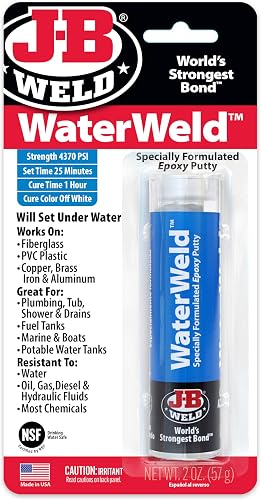
Best for: Submerged leaks and potable water systems.
This two-part epoxy putty is hand-mixable, allowing you to shape it exactly where the leak is located. It’s certified by the NSF International for safety, meaning it’s suitable for use on pipes that carry drinking water. Because it cures under water, it’s an excellent choice for repairs in areas that are difficult to dry out completely.
The putty takes 25 minutes to set and a full hour to cure, so it requires more patience than a quick-setting wrap. It isn’t designed for high-pressure industrial lines, as its lap shear strength is 1300 PSI, which is lower than some dedicated fiberglass wraps.
Pros
- Safe for potable water
- Cures under water
- Heat resistant to 300°F
Cons
- Longer cure time
- Lower PSI rating
3. RectorSeal Pipe Repair 82112 Pipe Repair Kit

Best for: High-pressure plumbing and HVAC systems.
This system uses a knitted fiberglass cloth and polyurethane resin to create a strong seal on rigid pipes. It’s engineered for the professional trades, making it a robust option for those dealing with heating, cooling, or irrigation lines. It’s specifically recommended for pipes up to 1 inch in diameter and can be submerged in water after the initial cure.
Because it relies on a specific resin-to-cloth ratio, it’s best suited for users who follow instructions carefully to ensure the bond forms correctly. It may not be the right choice for someone working on very large diameter pipes, as the kit is optimized for standard residential plumbing lines.
Pros
- Bonds to any material
- Heat resistant
- Professional-grade durability
Cons
- Designed exclusively for standard household pipe diameters.
- Requires precise installation
4. Do it 410353 Pipe Repair Clamp

Best for: Quick mechanical fixes without adhesives.
This repair clamp uses plated steel to provide a physical seal around a leaking joint. Because it requires no special tools and no drying time, it’s ideal for an emergency situation where you can’t wait for an epoxy to harden. It fits 3/8, 1/2, and 3/4 inch IPS pipes, giving it versatility for common residential plumbing sizes.
The clamp is designed for a compact fit, which helps when you’re working in tight spaces behind walls or under sinks. However, it’s a mechanical solution rather than a chemical bond, so it may not be suitable for complex, irregular cracks that require a filler.
Pros
- No drying time
- Reusable design
- Fits multiple pipe sizes
Cons
- Mechanical seal only
- Limited to specific pipe diameters
5. Romeda 1 Inch x 10 FT Black Self-Fusing Silicone

Best for: Insulating and sealing low-pressure hose leaks.
This silicone tape fuses to itself to create a waterproof, insulating barrier. It’s highly resistant to temperature extremes, functioning safely between -50°C and 250°C, which makes it useful for more than just standard plumbing. Because it doesn’t use a sticky adhesive, it won’t leave a messy residue if you eventually need to remove it.
It’s primarily intended for domestic water pipe leakage and isn’t designed for high-pressure main lines. If you’re looking for a solution that can hold back significant water pressure, this tape should be used with caution, as it’s better suited for low-pressure or non-pressurized hose applications.
Pros
- No adhesive residue
- Wide temperature range
- Easy to apply
Cons
- Best for low pressure
- Can’t fill large holes
6. Loctite 209818 Pipe Repair Kit

Best for: Professional-grade, long-term pipe reinforcement.
This kit provides a 2-inch by 6-foot wrap designed for durability and ease of use. It comes from a brand recognized for industrial adhesives, suggesting a high level of reliability for household repairs. The package is lightweight and compact, weighing only 0.3 pounds. This makes it an easy addition to a standard home tool kit for emergency preparedness.
Because the listing provides limited technical specs compared to other kits, it’s best for users who are already familiar with applying resin-based fiberglass wraps. If you have never handled industrial resin before, practice on a scrap piece of PVC first to gauge the material’s tackiness. It may not be the best choice for a beginner who needs detailed, step-by-step guidance on curing times or pressure ratings.
If you’re dealing with a high-pressure line, avoid this kit unless you can confirm the pipe diameter matches the 2-inch width. Using this on a pipe significantly larger than the wrap width will compromise the structural seal.
Pros
- Compact package size
- High-quality brand reputation
- Simple wrap application
Cons
- Minimal technical specs
- Requires careful wrapping
7. Christy’s Slick-Wrap Pipe and Hose Repair Kit

Best for: Versatile hose and pipe repairs.
This kit combines an epoxy-impregnated tape with a piece of FastFix epoxy putty, giving you two ways to address a leak. By using 8 wraps over the break, you can achieve a repair rated for up to 300 PSI. It works on almost any pipe material, including metal, plastic, and fiberglass.
The ability to cure underwater makes it very flexible for emergency situations where you can’t fully shut off the water source. However, it requires a specific number of wraps to achieve its maximum pressure rating, so it isn’t for someone who wants a “one-size-fits-all” quick fix without following specific application steps.
Pros
- Includes putty and tape
- Cures underwater
- Works on many materials
Cons
- Requires specific wrap count
- Moderate PSI limit
8. Pipe Repair Clamp Kit-3/4 Inch(26-29mm) High Pressure Resistant Pipe Coupling

Best for: Metal pipe leaks in emergency situations.
This clamp is made of 304 stainless steel and features a high-density rubber inner ring to provide a reliable seal. It’s specifically designed to eliminate leaks in plastic and metal pipes, and it’s reusable if you need to move it to a different location. The integrated body design helps distribute pressure evenly across the leak.
Measure your pipe’s outer diameter before purchasing. If your pipe measures exactly 26mm to 29mm, this clamp is a precise fit. If the diameter falls outside this narrow range, the seal will fail. Don’t guess your pipe size, as a mismatch prevents the high-density rubber from compressing correctly.
You can use this kit on various materials, including cast iron, cement, PVC, and PE pipes. It works equally well for burst sections or simple pipe connections. The dual-sided connection ensures that pressure remains balanced across the repair site. This design allows even those with limited plumbing experience to stop leaks quickly.
Pros
- Reusable stainless steel
- Even pressure distribution
- Easy to install
Cons
- Very specific sizing
- Metal-focused design
9. Pow-R Pipe Wrap

Best for: Heavy-duty, straightforward plumbing wrap.
This wrap is a specialized tool for plumbing repairs. Its size makes it suitable for wrapping around mid-sized pipes to provide a reinforced, protective layer. It’s a no-frills option that focuses on the essentials of pipe wrapping.
Because the listing details are sparse, this product is best suited for users who know exactly how to apply a fiberglass wrap and don’t need extra instructions or auxiliary tools. If you’re working on a standard plumbing leak and already have the necessary safety gear, this length provides enough coverage for a secure, multi-layered seal.
It may not be the best choice for someone who is completely new to plumbing repairs and requires a comprehensive kit with included putty or gloves. If your pipe surface is heavily corroded or irregular, you must source a separate epoxy putty to ensure the wrap adheres properly. Without that base layer, the wrap will fail to create a watertight seal.
Pros
- Generous wrap length
- Focused plumbing application
- Simple to use
Cons
- Lacks extra accessories
- Limited feature info
10. Pipe Repair Patch Kit

Best for: Emergency fixes in diverse environments.
This kit is unique because it offers two different types of material: an epoxy for dry pipes and a rubber patch for pipes where water is still running. It’s a popular choice for emergency DIY repairs and is compatible with a wide range of materials, including PVC, metal, and wood.
Because it’s manufactured by an orthopedic splint company, it uses technology adapted from medical-grade materials to provide a strong, permanent bond. It isn’t for someone who only wants a single, simple wrap, as you must decide which of the available patch types is appropriate for your specific leak conditions.
Pros
- Includes dry/wet options
- Broad material compatibility
- Medical-grade technology
Cons
- Requires choosing the type
- Slightly more complex
How to Choose in Sixty Seconds
Which repair method is actually best for my leak?
The best method depends on the pipe material and whether the leak is a pinhole or a crack. For small pinholes in metal or plastic, an epoxy putty like J-B Weld WaterWeld is effective because it molds into the hole. If you have a larger crack, a fiberglass wrap like FiberWeld Pipe Repair Cast is better because it reinforces the structural integrity of the pipe. If you need an immediate, non-chemical fix, a mechanical clamp like Do it Pipe Clamp is the safest bet. Always identify your pipe’s outer diameter before choosing.
Do I need to shut off the water completely?
Most resin-based wraps and epoxy putties perform best when water pressure is off, as the material needs time to bond to the surface without being pushed away by water. However, some products, like the Pipe Repair Patch Kit, are specifically designed to handle active leaks with rubberized patches. If you can’t stop the leak entirely, look for a product that explicitly mentions it can be applied to wet surfaces or under water. For high-pressure pipes that can’t be shut down, mechanical clamps are usually the only reliable, immediate solution.
What should I confirm before ordering a repair kit?
Always verify the outer diameter of your pipe, not just the nominal size. Standard household pipes often have a larger outer diameter than their nominal size, and a clamp that’s too small won’t fit, while one that’s too large won’t seal. Check the PSI rating of the kit to ensure it can handle your home’s water pressure, which is typically within the range of standard household water pressure. Finally, confirm the pipe material compatibility; while most kits are versatile, some are specifically optimized for metal or plastic, and using the wrong one might lead to a weak bond.
Related guides
- 10 Best Hearing Aid Amplifier Cleaning Kits for Daily Care in 2026
- 7 Best Performance Timing Part Sets Kits for Engine Harmony in 2026
- 9 Best Computer Mobile Device Repair Kits for Every Project in 2026
Frequently Asked Questions
What materials do these repair kits work on?
Most repair kits are versatile and compatible with copper, cast iron, PVC, ABS, and galvanized steel. Always check the product listing, as some mechanical clamps are optimized for metal while certain epoxy putties are better suited for plastic. Ensure your specific material is listed to avoid a poor seal.
What kind of maintenance does a repaired pipe require?
Pipe repairs generally require little maintenance if applied correctly to a clean surface. You can sand and paint wraps like FiberWeld Pipe Repair Cast to match the surrounding area, while mechanical clamps should be checked periodically to ensure bolts remain tight. Monitor the area for any signs of new moisture.
What typically goes wrong first with these kits?
The most common failure point for these kits is improper surface preparation, such as applying them to dirty or greasy pipes. If the surface isn’t cleaned, the epoxy or resin cannot form a proper bond, leading to leaks. Always ensure the pipe is free of debris before beginning the application.
Is the simplest kit on the list enough for my leak?
For simple pinhole leaks in low-pressure lines, a basic solution like self-fusing tape or a mechanical clamp is often sufficient. These options are easy to use and do not require the curing time of complex resin kits. However, if the pipe is under high pressure, a reinforced wrap is safer.
Closing
For most household leaks, the FiberWeld Pipe Repair Cast is the most reliable all-around choice due to its rapid hardening and 1800 PSI bend strength. If you’re dealing with a leak in a submerged area or need a solution safe for drinking water, the J-B Weld WaterWeld is the superior option, as it’s NSF-certified and cures underwater.
Before starting any repair, measure your pipe’s outer diameter carefully. If you’re using a clamp, ensure the inner diameter matches your pipe size exactly to avoid a mismatch. Use epoxy putty for pipes where you can stop the water flow, but switch to a mechanical clamp or specialized rubber-backed repair kit if you can’t shut off the line. Keeping a mechanical clamp on hand is a smart way to handle sudden emergencies. Always verify the material compatibility of your chosen kit, as some resins bond better to metal than plastic.