
Portable natural gas and propane detectors pinpoint leaks, while static alarms provide continuous home monitoring. Portable units prioritize reach and sensitivity for locating sources, whereas alarms offer passive safety. The main difference lies in whether you need to actively hunt for a leak or keep a constant watch.
As an Amazon Associate, we earn from qualifying purchases. This post contains affiliate links – if you buy through them, we may earn a commission at no extra cost to you.
Best overall: Klein Tools ET120, which offers a wide detection range and an 18-inch flexible probe that makes it a versatile, reliable choice for most homeowners and professionals alike.
Best for active leak hunting: TopTes PT-830S, which features a detailed TFT color display and vibration alerts, making it perfect for users who want clear, real-time data while navigating tight spaces.
Best for static home safety: Kidde Digital Alarm, which is ideal for those who want a simple, plug-in solution that monitors for both carbon monoxide and explosive gases continuously.
The rest of this guide is for homeowners and technicians who need to identify potential gas leaks safely and accurately.
How We Picked
We compared 48 different gas leak detector listings to find the most capable tools for residential and professional use. To make our list, a product had to clearly state its detection range, probe length, and the specific alarm types it uses to notify the user. We removed any products that lacked clear specifications regarding their sensor capabilities or power methods. Our selections focus on the balance between ease of use, durability, and the precision of the provided safety alerts.
1. Klein Tools ET120 Gas Leak Detector

Best for: Homeowners needing a reliable, all-around leak detector.
The Klein Tools ET120 features a wide detection range from 50 to 10,000 ppm, providing versatility for various gas monitoring needs. Its 18-inch flexible gooseneck allows you to reach behind appliances or into tight corners where gas might collect. The automatic zero-point calibration at start-up helps ensure you’re getting accurate readings from the moment you turn it on.
The visual and audible alerts are designed to intensify as the gas concentration increases, which helps you quickly narrow down the source of a leak. This unit isn’t suited for users who need to log historical data, as it’s designed for real-time, active detection only.
Pros
- Wide 50-10,000 ppm range
- Flexible 18-inch gooseneck probe
- Automatic zero-point calibration
Cons
- No data logging feature
- Requires manual active scanning
2. TopTes PT-830S Rechargeable Gas Leak Detector with 14.5 Inch Flexible
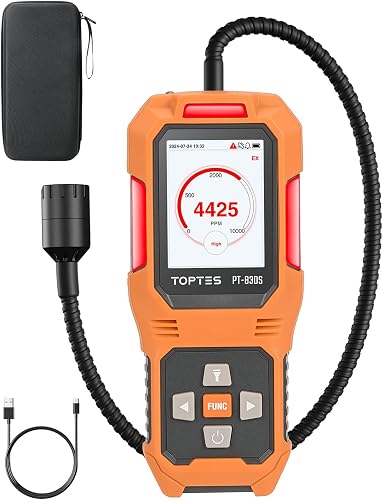
Best for: Users who want detailed, real-time visual data.
The TopTes PT-830S stands out with its large TFT color display, which shows PPM values, battery status, and sensitivity levels in real time. It uses a Figaro sensor to measure concentrations up to 10,000 ppm, and the 14-inch gooseneck is built for reaching difficult spots. You can customize the high and low alarm thresholds to suit your specific environment.
The unit includes three alarm modes—buzzer, light, and vibration—which can be enabled or disabled based on your preference. It isn’t for users who prefer a simple, “no-settings” device, as the menu system offers many options that may feel unnecessary for basic tasks.
Pros
- Large, clear TFT display
- Triple alarm system
- USB-C rechargeable battery
Cons
- Menu can be complex
- Slightly shorter probe than competitors
3. PT520B+ Gas Detector
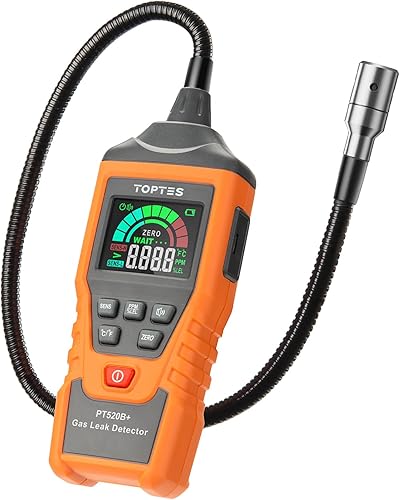
Best for: Reaching deep into tight or hidden spaces.
The PT520B+ Gas Detector provides a long 17-inch probe that’s excellent for navigating behind stoves, pipes, and into basement areas. It offers a quick response time of 0.5 seconds and displays readings in both PPM and %LEL. The inclusion of a mute button is useful if you need to eliminate the 75dB alarm noise while you continue your search.
This detector requires a 30-second warm-up period before it’s ready for use. It isn’t for users who need an instant-on device, as you must wait for the sensor to stabilize before you can begin your inspection.
Pros
- Long 17-inch flexible probe
- Quick 0.5s response time
- Mute button for alarms
Cons
- Requires 30-second warm-up
- No built-in storage case
4. Kidde Carbon Monoxide + Explosive Gas

Best for: Continuous, hands-off home safety monitoring.
The Kidde Digital Alarm is a plug-in unit that provides 24/7 monitoring for carbon monoxide and explosive gases. It features a digital LED display that clearly states “GAS” when explosive levels are detected, removing the guesswork during an emergency. The 9V battery backup ensures that the device continues to function even if your home loses electrical power.
This is a static alarm, not a handheld tool for finding leaks in specific pipes or appliances. If you need to track down the source of a leak, you must use a portable sensor instead. This unit is strictly for stationary protection in one room. People often mistake this for a diagnostic tool, which leads to frustration when they can’t pinpoint a leak’s origin.
The Peak Level Memory feature adds value by recording the last time carbon monoxide was detected or when the unit was last tested. Use this data to track recurring issues in your home environment.
Pros
- Dual-purpose gas and CO detection
- Simple plug-in installation
- Reliable 9V battery backup
Cons
- Not a handheld tool
- Static, fixed-location device only
5. TopTes PT-990 Rechargeable Gas Leak Detector with 11 inch Probe

Best for: Professionals who need to log inspection data.
The TopTes PT-990 is designed for versatility, featuring a data logging function that records alarm times and PPM readings. It uses an active fan to draw in air, which helps achieve a very fast 0.5-second response time. The dual display shows both real-time PPM numbers and a dynamic trend line graph for easier concentration tracking.
The unit is powered by a 4000mAh battery that lasts over 9 hours, making it suitable for long work shifts. It isn’t for the casual user who doesn’t need to keep records of their inspections, as the logging features add complexity to the device.
Pros
- Data logging capabilities
- Active fan for faster response
- Long battery life
Cons
- More complex for simple tasks
- Heavier than basic sniffers
6. UEi Test Instruments CD100A Combustible Gas Leak Detector

Best for: HVAC contractors and professional technicians.
The UEi Test CD100A is built for detecting a wide range of gases, including butane, methane, and LPG, making it a staple for HVAC professionals. The 18-inch flexible gooseneck includes a tip light, which is helpful when you’re working in dark cabinets or behind appliances. It uses an escalating tic rate to help you find the source of a leak.
This device requires a 10-second warm-up time in open air before use. It isn’t for homeowners who want a device that displays specific concentration numbers, as this unit relies on auditory and visual tic-rate cues instead.
Pros
- Includes probe tip light
- Professional-grade build
- Detects many gas types
Cons
- No digital PPM display
- Requires manual warm-up
7. TopTes PT760 Rechargeable Natural Gas Detector

Best for: Users needing a compact, portable detector.
The TopTes PT760 features a 12-inch stainless steel telescopic probe that retracts, making the device very easy to store and carry. It detects a range of gases including propane and methane, and it shows the %LEL on the screen. The built-in flashlight is a helpful addition for inspecting dark, narrow areas.
To get an accurate reading, keep the sensor 1 to 5 cm from the suspected leak point. This is a targeted tool for pinpointing leaks, not a passive monitor like a standard smoke alarm. If you’re checking behind cabinets or inside pipes, the telescopic rod allows for precise navigation.
The device requires a 30-second preheat time with a countdown timer shown on the display. It isn’t for users who need a very long reach, as the 12-inch probe is shorter than other models on this list. Upon detection, the unit triggers an alarm within 0.5 seconds. You can gauge the severity of the leak by the frequency of the tone and the color changes on the screen.
Pros
- Telescopic probe for compactness
- Clear %LEL display
- Built-in flashlight
Cons
- Shorter probe reach
- Requires a brief preheat period before it is ready for use.
8. MTI Industries 30-442-P-WT Propane Gas Alarm

Best for: RV owners needing a permanent propane alarm.
The MTI Industries 30-442-P-WT is a dedicated propane alarm designed for Class A, B, and C motorhomes, travel trailers, and fifth wheels. Its flush-mount build serves as a direct replacement for most CCI Controls detectors, requiring no modifications during installation.
The unit runs on 12V DC power, drawing 90mA, which removes the burden of frequent battery replacements. If you’re replacing an older unit, ensure your system operates within 12V ±15% to maintain reliable performance. The sensor is self-cleaning and maintenance-free, built to function in extreme temperatures ranging from -40°F to +158°F.
While the 85 dB alarm provides dependable protection, it isn’t a tool for pinpointing leak sources. Use the mute button to ventilate the area during a false alarm, but remain alert; the sensor reactivates rapidly if propane levels stay above 25% LEL. If you require a portable device to track gas flow, this fixed-mount unit won’t meet your needs.
Pros
- Dedicated RV propane alarm
- Maintenance-free sensor
- Operates on 12V power
Cons
- Fixed installation only
- No handheld functionality
9. Gas Leak Detector by Forensics
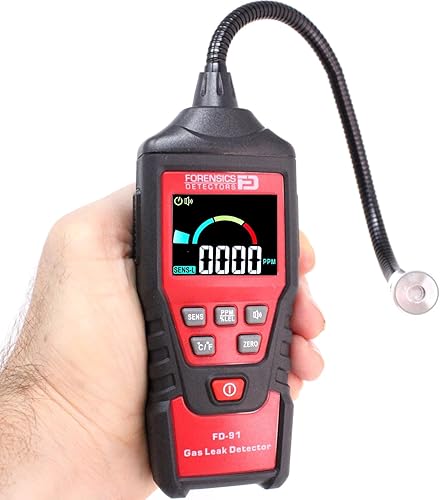
Best for: Harsh environments and rugged job sites.
The Forensics Gas Detector is built with an ABS housing that has passed a 10-foot drop test. This makes it a durable choice for field work where equipment often hits the ground. It uses a high-quality sensor made in Japan and is calibrated for methane. The large color LCD screen provides clear readings along with ambient temperature information.
If you’re an inspector, technician, or engineer, this tool provides the necessary reliability for daily industrial use. However, don’t choose this model for simple residential checks. If you only need to verify a single stove connection, the industrial-grade construction and specialized calibration will likely be more than what you require. You’ll pay for durability you don’t need.
The sensor is rated for a 7-year lifespan, provided you don’t expose it to extreme contaminants. If your work involves constant exposure to heavy chemicals, budget for a replacement sensor sooner.
Pros
- Extremely durable ABS housing
- High-quality Japanese sensor
- Large, informative LCD display
Cons
- Overbuilt for basic home use
- Heavier than pocket-sized models
10. Klein Tools ET190 Compact Gas Leak Detector

Best for: Quick, simple checks in a pocket-sized format.
The Klein Tools ET190 is a slim, pocket-sized detector that’s very easy to carry and use. It features dual sensitivity modes, allowing you to toggle between high and low settings to pinpoint leaks more accurately. The device performs an automatic zeroing process upon start-up, which makes it ready for use with minimal effort.
This is a compact tool, which means it lacks a long, flexible gooseneck probe for reaching deep into hidden areas. It isn’t for users who need to reach behind large appliances or into narrow pipes where a longer probe is necessary.
Pros
- Slim and pocket-sized
- Dual sensitivity modes
- Easy automatic zeroing
Cons
- Lacks long flexible probe
- Less reach than gooseneck models
How to Choose in Sixty Seconds
Which type of detector do I need?
You need to decide between a portable sniffer and a fixed alarm. If you suspect a specific leak in a stove, pipe, or valve, a portable handheld sniffer like the Klein Tools ET120 or TopTes PT-830S is the right choice. If you want continuous monitoring while you’re at home, a static alarm like the Kidde Digital Alarm is necessary.
Does the sensor type matter for my safety?
The sensor technology determines how accurately and quickly a device reacts to different combustible gases. Most modern sniffers use semiconductor sensors, often referred to as Figaro sensors, which are highly effective at detecting methane, propane, and butane. Always ensure your detector is rated for the specific gas you’re concerned about, as some units are calibrated primarily for methane while others are more versatile for general combustible gas detection.
What features should I prioritize for ease of use?
Prioritize the probe design and the alert system based on your comfort level. If you aren’t a professional, look for devices with automatic calibration and clear, easy-to-read displays, such as the TopTes PT-830S or PT-990. These models remove the guesswork by showing you exactly what the sensor is picking up. If you’re working in tight or dark spaces, a model with a long, flexible gooseneck and a built-in flashlight, like the UEi Test CD100A, will make your job much easier. Avoid units with overly complex menus if you only need to perform occasional, simple checks around your home.
Frequently Asked Questions
What does a gas detector actually need to work correctly?
A gas detector must be calibrated in fresh air to ensure accurate readings. Most handheld units perform an automatic zeroing process upon power-up. Always perform this step in an uncontaminated environment to avoid false readings or missed leaks.
What does owning a leak detector ask of the buyer afterwards?
Regular maintenance ensures your leak detector remains sensitive and functional. Keep the probe and intake vents free of dust and debris to prevent sensor blockages. Always store the device in its protective case to avoid sensor contamination when not in use.
What goes wrong first with these detectors?
The flexible probe or the sensor is typically the first point of failure. Kinking the gooseneck probe can break internal wiring, while frequent exposure to high gas concentrations eventually degrades sensor sensitivity. Consult your manual if the device provides inconsistent readings after a proper warm-up.
Is the simplest one on the list enough for my home?
A simple model like the Klein Tools ET190 is sufficient for basic household leak detection. These intuitive devices effectively pinpoint leaks in common areas like gas stoves or pipe joints. You do not need advanced features if your goal is simply to identify a leak source.
Closing
For most users, the Klein Tools ET120 remains the best overall choice due to its balance of reach, range, and simplicity. If you need more advanced features like data logging or a visual trend graph, the TopTes PT-990 is a highly capable alternative.
Before you begin your inspection, ensure your detector is fully charged and perform the initial warm-up in a fresh-air environment away from the suspected leak. Many models require a short warm-up period to calibrate correctly.
When scanning for leaks, keep the sensor 1 to 5 centimeters from the suspected point. This distance is critical, as these handheld tools are designed for point-to-point detection rather than general area monitoring like a smoke alarm.
If you ever detect a strong smell of gas, evacuate the area immediately and contact your local utility provider or emergency services. These tools are for identification, not for emergency mitigation.