
Full disclosure: we are an Amazon Associate and earn a commission on qualifying purchases made through the links on this page. You pay exactly the same either way.
Finding the right tools to identify refrigerant loss can be a frustrating process for any technician. Whether you’re working on a home system or a car, the goal remains the same: pinpointing the leak quickly to avoid wasting gas. When searching for the best air conditioning leak detection tools, you’ll find two main paths: electronic sniffers that alert you to gas concentrations, or physical test kits that help you pressure-test the lines.
Choosing between these comes down to how you prefer to work. Electronic detectors offer speed and automation, while manual test kits provide a physical way to isolate sections of a system. These comparisons help you weigh different approaches to find the right solution for your specific service needs.
1. Elitech HVAC Refrigerant Leak Detector 10 Yrs Infrared Sensor Life

Right for: Professionals needing a long-lasting, reliable electronic sensor.
The Elitech Infrared Leak Detector uses infrared technology, which offers a 10-year sensor life. Its 2.8-inch screen provides a clear view of the peak leak intensity, helping you track down the source without guessing.
In daily use, this detector is helpful for technicians who need to work in quiet environments. It’s designed to ignore interference, so you spend more time making repairs rather than troubleshooting false alarms.
What works:
- Long 10-year sensor life
- Clear peak leak display
- Reliable infrared sensor technology
- Detects all common halogen refrigerants
Where it gives ground:
- Higher sensitivity requires careful calibration
- Larger physical size than basic sniffers
Skip it if: You prefer a compact, pocket-sized device for quick, occasional checks.
2. Elitech HVAC Refrigerant Leak Detector Heated Diode Sensor Halogen Freon

Right for: Technicians who prioritize fast, precise sensor reaction times.
This model features a heated diode sensor designed for high accuracy across a wide range of refrigerants. The inclusion of a TFT screen simplifies the process by displaying battery levels and sensitivity settings, making it easy to monitor the device during a job.
When you’re out in the field, the quick-response time is useful for scanning large areas. It allows you to move the probe along lines at a steady pace while watching the screen for any shifts in gas concentration.
What works:
- Fast one-second response time
- Clear TFT screen interface
- Easy-to-use front button layout
- Supports all halogenated refrigerants
Where it gives ground:
- Requires periodic sensor maintenance
- Battery life depends on usage intensity
Skip it if: You rarely work with complex refrigerant blends or newer HFO gases.
3. Mastercool 55600 Black Series Infrared Refrigerant Leak Detector

Right for: Users who need a tool compliant with strict industry standards.
The Mastercool Black Series Detector is designed to meet EN14624, SAE1627, SAE2791 and SAE2913 standards. Its infrared sensor is built for longevity, and the color-coded TFT screen provides clear visual feedback on leakage and sensor health.
For a professional, this means you can trust the readings when working on high-end or sensitive cooling systems. The auto-off function is a practical feature that helps preserve battery life during long days on the job site.
What works:
- Meets multiple professional industry standards
- Extended 10-year sensor life
- Color graphics for easy reading
- Integrated peak leakage button
Where it gives ground:
- Not designed for casual DIY tasks
- Screen relies on clear visibility
Skip it if: You’re a beginner looking for a simple, entry-level starting tool.
4. ALD-200 Refrigerant Leak Detector with 16-Inch Probe Rechargeable

Right for: Technicians needing a durable tool for harsh job sites.
The ALD-200 is built with an impact-resistant and oil-resistant housing, making it a rugged choice for busy workshops. Its 16-inch probe provides the reach necessary to get into tight spots around condensers and evaporators.
On an ordinary day, the “3-in-1” detection capability allows you to switch between various refrigerant types without needing multiple devices. The peak mode helps capture the highest reading, ensuring you don’t miss a micro-leak while moving the probe.
What works:
- Durable, oil-resistant housing
- Long 16-inch flexible probe
- Capable of detecting tracer gases
- Includes helpful reset function
Where it gives ground:
- Needs full charge before first use
- Sensitivity levels require manual adjustment
Skip it if: You need a device that works instantly without any warm-up time.
5. Rechargeable TFT Leak Detector

Right for: Users who want versatile alarm modes for noisy environments.
This detector offers sound, light, and vibration alerts for different jobsite conditions. The TFT display provides two different views, letting you choose between a trend graph or intensity visualization.
The USB-C rechargeable battery lasts up to 8 hours, which is enough for most daily service tasks. Its flexible gooseneck probe makes it easy to navigate around complex pipe connections and service ports.
What works:
- Multiple alarm modes for flexibility
- Clear real-time PPM readings
- Convenient USB-C charging
- Long flexible gooseneck probe
Where it gives ground:
- Vibration alert may drain battery faster
- Requires calibration in clean air
Skip it if: You prefer a simple, non-electronic method for finding leaks.
6. Gonetre Automotive Air Conditioning Leak Test Kit Premium Brass AC

Right for: Automotive enthusiasts who prefer manual pressure testing.
This 77-piece kit is a comprehensive solution for those who like to physically test automotive AC systems. Made from durable brass, these connectors are designed to withstand repeated use without wearing down.
Because this is a manual kit, it’s best for people who want to isolate specific parts, like a condenser or a compressor, to see if they hold pressure. The organized case keeps everything in its place, so you aren’t searching for the right size connector.
What works:
- Durable brass construction
- Very wide range of connectors included
- Organized storage case
- Essential for manual pressure testing
Where it gives ground:
- Doesn’t detect gas concentrations
- Requires more time to set up
Skip it if: You need to find a small, active leak while the system is running.
7. iDili Universal A/C Leak Testing Detector Tool Air Conditioning Pipeline

Right for: Mechanics working on a wide variety of vehicle models.
The iDili Universal Leak Tester is designed for compatibility with most vehicle air conditioning systems. It uses high-strength iron and rubber sealing rings to help you block off pipes for pressure testing.
This tool is simple and portable, making it an easy addition to any mechanic’s toolbox. The listing doesn’t mention how the iDili Universal Leak Tester functions.
What works:
- Broad compatibility with most vehicles
- High-strength material construction
- Compact and portable design
- Simple to use for pressure checks
Where it gives ground:
- Basic kit with no electronic features
- Manual operation only
Skip it if: You’re looking for an electronic device to sniff out gas leaks.
8. Vansky Air Conditioner Leak Detector

Right for: Users who prefer visual confirmation via fluorescent dye.
The Vansky UV Leak Detector uses a bright 68-LED flashlight to illuminate fluorescent dyes that you add to the system. The included yellow-filter glasses are essential, as they block out ambient light and make the dye glow clearly.
In practice, this is a great way to find slow, persistent leaks that electronic sniffers might miss. It’s particularly effective for automotive work, where you can trace the path of the dye to find the exact origin of the leak.
What works:
- High-brightness LED flashlight
- Includes protective yellow-filter glasses
- Durable aluminum alloy housing
- Good for both oil and fluid leaks
Where it gives ground:
- Requires purchase of fluorescent dye
- Not suitable for gas-only detection
Skip it if: You don’t want to add chemicals or dye to your AC system.
9. Elitech Freon Leak Detector Halogen Refrigerant Gas Leak Detector HVAC
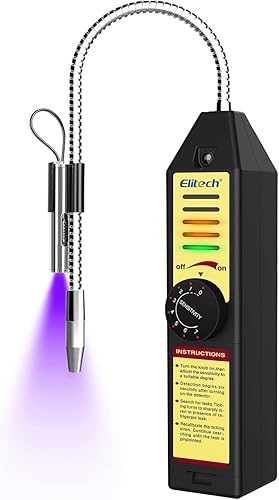
Right for: Beginners needing a compact, portable sniffer.
The Elitech WJL-600 is a straightforward, no-frills electronic detector. It’s designed to turn on and work quickly, with a warm-up time of only six seconds.
Its 7.9-inch probe is flexible enough to reach into most standard AC units. It provides clear audible and visual indicators when it detects a refrigerant leak.
What works:
- Very fast warm-up time
- Simple, easy-to-use knob control
- Compact and lightweight design
- Reliable audible and visual alerts
Where it gives ground:
- Lacks a high-resolution display
- Limited sensitivity range compared to others
Skip it if: You require precise digital readings or advanced graphs for documentation.
10. Fydun Air Conditioning Leak Test Kit
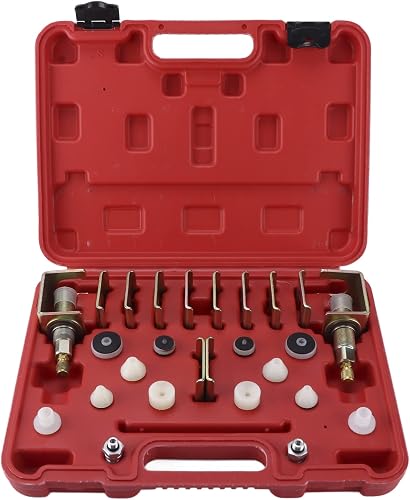
Right for: Technicians performing pressure testing on automotive pipes.
The Fydun Leak Test Kit includes 12 plugs and 10 buckles for use on automotive air conditioning pipes, condensers, evaporators, and drying bottles. This set is made of aluminum alloy.
Using this kit is a reliable way to confirm if a specific pipe or evaporator is the source of a leak. It’s a manual method, meaning it provides a definitive answer based on whether the pressure holds or drops.
What works:
- High-quality aluminum alloy material
- Includes a wide variety of plugs
- Professional-grade accuracy
- Traceable quality control
Where it gives ground:
- No electronics to detect gas
- Requires a pressure source
Skip it if: You’re looking for a tool that can “sniff” for leaks in the air.
How to Think Before You Choose
Electronic vs. Manual Methods
Electronic sniffers are best for finding active gas leaks while the system is under pressure. They’re fast and show you where the gas is concentrated. Manual kits, however, are better for isolating parts when you need to perform a static pressure test. Most pros keep both types of tools on hand. You can check the Environmental Protection Agency guidelines to understand the proper procedures for handling refrigerant leaks and equipment.
Sensor Technology Differences
Infrared sensors generally last longer and are less prone to false alarms from oil or humidity. Heated diode sensors are often faster at reacting to small concentrations, but they may need more frequent maintenance. If you work in a variety of environments, consider how often you want to calibrate your device. Infrared is often the better choice for long-term reliability in professional settings.
Display and Readability
A high-quality TFT screen makes a big difference when you’re working in tight, dark spaces like a crawlspace or a car engine bay. Look for a display that shows clear trend graphs or peak values. If you prefer to keep your eyes on the equipment, choose a model that offers sound or vibration alerts so you can work without looking at the screen constantly.
Who Should Skip These Altogether
- Homeowners who only need to check a filter and have no experience with refrigerant systems.
- Anyone who already owns a professional-grade leak detector that meets their current service needs.
- People working on systems that don’t use halogenated refrigerants, as these tools won’t work.
- Someone who only needs to perform a one-time check and would prefer to hire a licensed professional.
HVAC Refrigerant Leak is a solid choice for those who need a basic, rechargeable sniffer for intermittent use. Lichamp AC Leak Detector Kit serves as a reliable alternative for those who prefer the visual clarity of UV dye without needing a large kit. Universal 2-in-1 Air Conditioning Leak provides a simple, combined approach for mechanics who want both basic detection features in a single, portable unit.
Frequently Asked Questions
Do these electronic detectors work on all types of refrigerant?
Most electronic detectors featured here are designed to work with all common halogenated refrigerants, including HFCs, CFCs, and HCFCs. Always check the product specifications to ensure your specific refrigerant, such as R134a or R410a, is listed. These tools are built to handle the most common gases used in residential and automotive systems.
How often should I calibrate my electronic leak detector?
Calibration frequency depends on the sensor type and how often you use the device. Many models, such as the ALD-200, feature auto-zero calibration that works in clean air before each use. If you notice the device giving false alarms in clean areas, it’s time to perform a manual recalibration according to the user manual.
What causes a leak detector to give false alarms?
False alarms can be triggered by high humidity, strong chemical odors, or even smoke in the work area. To reduce these, use the “reset” function found on models like the ALD-200 to recalibrate the sensor to the current environment. If the issue persists, ensure the sensor tip is clean and free of oil or debris.
Is the simplest pick enough for a DIY user?
For a DIY user checking a home AC unit or a car, a simpler model like the Elitech WJL-600 is often sufficient. These tools provide the necessary audible and visual alerts to find a leak without the complexity of a high-resolution TFT screen. They’re easy to operate and perform the core job of finding gas leaks effectively.
What should I look for before ordering a kit?
Before ordering, confirm that the kit includes the specific fittings or probes required for your vehicle or AC system. For manual kits, check the size of the plugs and buckles included in the set. For electronic detectors, ensure the probe length is sufficient for the spaces you need to inspect, such as deep engine bays.
Final Thoughts
Investing in high-quality equipment saves you time and keeps your customers’ systems running smoothly. Don’t wait for a major breakdown to upgrade your toolkit. Check your current gear for wear today, and you’ll be ready to tackle any cooling challenge that comes your way. It’s a smart move for your business.