
Selecting a PEX tool depends on your preference for manual control or power-assisted speed, as well as the need to access tight spaces. These options vary by mechanical design, ring compatibility, and the physical effort required to complete a connection.
As an Amazon Associate, we earn from qualifying purchases. This post contains affiliate links – if you buy through them, we may earn a commission at no extra cost to you.
Best overall: iCrimp PEX Cinch Tool, because its multi-function design allows you to both cinch and remove clamps, making it a versatile choice for fixing mistakes without wasting fittings. Best for tight spaces: iCrimp Angle Crimp Tool, as its angled head design allows you to reach into cramped joist bays where standard straight-handled tools simply can’t fit or operate effectively. Best for beginners: SHALL PEX Cinch Tool, because it includes a complete kit with clamps, a cutter, and a calibration tool, removing the guesswork for those starting their first plumbing project.
This guide is for anyone tackling home plumbing repairs or new installations who needs to understand the trade-offs between manual and powered crimping methods.
How We Picked
We compared 48 different product listings to find the most reliable options for PEX installation. To earn a spot, each tool had to clearly state its compatibility with industry standards like ASTM F2098 or F1807, ensuring the connections meet safety requirements. We prioritized listings that included essential details about jaw construction, handle ergonomics, and whether the tool requires manual calibration. Products were excluded if they lacked clear specifications or failed to provide information on the range of pipe sizes they support.
1. iCrimp PEX Crimping Tool Kit

Best for: Homeowners needing both installation and removal capabilities.
This tool stands out because it combines cinching and clamp removal in one frame. The listing doesn’t mention the benefit of saving fittings. The ratcheting design takes the heavy lifting out of the process, allowing for consistent pressure on every clamp.
It might be larger than some basic pliers, which could make it slightly less convenient for very narrow spaces. If you only need to perform a single, simple installation and never plan to fix or adjust your work, this multi-function tool might offer more features than your specific project requires.
Pros
- Dual-function cinch and removal
- Meets ASTM 2098 standard
- Includes PEX pipe cutter
Cons
- Larger size than basic pliers
2. RYOBI ONEAND 18V Lithium-ION Cordless PEX TUBING CLAMP Tool Tool

Best for: Professionals already using the 18V battery system.
This cordless tool is designed for those who want to automate the clamping process to reduce physical strain. By using a battery-powered motor, it takes the manual effort out of the equation, which is helpful if you have many connections to make in one day.
Pros
- Cordless battery-powered operation
- Reduces manual clamping effort
- Part of 18V ecosystem
Cons
- Requires separate battery purchase
3. DeWalt Impact Connect Attachment

Best for: Users who already own a compatible impact driver.
This attachment turns your existing impact driver into a PEX crimping tool, which significantly speeds up the workflow. It’s designed to clamp six times faster than a hand tool, making it ideal for larger projects where productivity is the main goal.
It requires a compatible 20V MAX or 18V impact driver to function, so it isn’t a standalone tool.
Pros
- Extremely fast clamping speed
- Fits into tight joist bays
- Features a completion indicator
Cons
- Needs compatible impact driver
4. iCrimp ICP-BJ02 PEX Clamp Cinch Tool

Best for: Working in tight spots where you need one free hand.
The patented one-handed ratcheting design is the highlight here. It allows you to hold the pipe in place while you operate the tool. This is a massive advantage when working on ladders or under sinks where you lack a second hand to steady the tubing.
The tool handles 3/8-inch, 1/2-inch, 3/4-inch, and 1-inch PEX clamp rings. Because it’s factory calibrated, it won’t release from the ring until a secure connection is made. If the tool refuses to open, don’t force it; the mechanism is intentionally locked to ensure you have met the ASTM F2098 standard.
The tool is strictly for cinching and doesn’t offer a removal function. Avoid this model if your project requires frequent adjustments or teardowns, as you’ll need a separate cutting tool for those tasks. The solid metal construction provides durability, while the textured grips prevent slipping in damp environments.
Pros
- The design allows for effortless single-handed use.
- Factory calibrated for accuracy
- Secure grip with textured handles
Cons
- No clamp removal function
5. iCrimp Angle PEX Crimping Tool for 1/2-inch & 3/4-inch PEX

Best for: Reaching into cramped plumbing corners.
The angled head is specifically built to maneuver around obstacles that straight tools can’t clear. This design allows you to create secure connections in tight spaces without needing to disassemble surrounding structures. Because the mechanism requires minimal force, you can complete these difficult crimps even when your leverage is restricted by a wall or joist.
This tool is strictly limited to 1/2-inch and 3/4-inch copper crimp rings. It won’t work for larger PEX pipe sizes. If your project requires a tool that handles a full range from 3/8-inch up to 1-inch, you must choose a different model.
Always use the included Go/No-Go gauge after every crimp.
Pros
- Angled head for tight spaces
- Includes Go/No-Go gauge
- Minimal force required
Cons
- Limited to two sizes
6. Professional PEX Crimp Kit

Best for: Users needing versatility across five different pipe sizes.
This kit includes five interchangeable dies, making it the most versatile option for someone working on mixed-size plumbing projects. The 180-degree rotatable head provides the flexibility needed to reach complex angles in basements or bathrooms.
Because it uses a hydraulic system, it’s physically larger and heavier than standard manual cinch tools. It isn’t the right fit for a user who prefers a lightweight, compact tool for simple, one-off home repairs. If you’re working in tight quarters, ensure the crimping fitting sits at least 1.5 inches away from the wall to allow the head to function.
Always verify a die is installed before applying the 80KN of hydraulic force. Failing to do so can damage the reinforced jaws.
Pros
- Covers five different sizes
- 180-degree rotatable head
- High-impact hydraulic force
Cons
- Heavier than manual tools
7. SHALL Pex Crimping Clamp Cinch Tool and Pipe Hose Cutter

Best for: Beginners who want an all-in-one starter set.
This kit is designed to get you started immediately by including the tool, a cutter, clamps, and gloves. The 8.5-inch handle provides enough leverage to make the crimping process feel easier for those who aren’t used to plumbing work.
The tool is factory-adjusted, meaning you shouldn’t attempt to calibrate it before your first use. If you’re working with single-ear hose clamps, check that the ear dimensions fit within the jaw opening before you begin. If the ear is too wide for the opening, the tool won’t close properly and the connection will fail.
The kit is focused on stainless steel clamps, so it isn’t compatible if your project requires copper crimp rings.
8. RIDGID 43853 1/2″ Close Quarters ASTM F 1807 Manual PEX
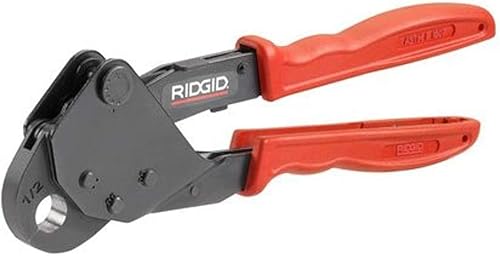
Best for: Small spaces requiring a high-quality manual tool.
This tool is built with a 71% smaller handle opening than standard tools, which makes it perfect for maneuvering in narrow gaps. The integrated Go/No-Go gauge that folds into the handle is a clever way to save space in your toolbox.
Use this crimper specifically for ASTM F1807 copper crimp rings in potable water or radiant heating systems. If you find your crimps aren’t meeting specifications, the adjustable cam allows for quick calibration to ensure optimal efficiency.
It’s strictly for 1/2-inch PEX tubing, so it lacks the versatility of kits that handle multiple sizes. If you’re working in a tight corner where a standard tool can’t swing, this is your primary solution.
Pros
- Very compact handle design
- Integrated calibration gauge
- Expert engineered ergonomics
Cons
- The tool is restricted to a single specific pipe diameter.
9. iCrimp 1-1/4 Inch Crimper

Best for: Projects involving larger diameter PEX piping.
This tool is specifically engineered for 1-1/4 inch copper rings, which are uncommon in standard home kits. The 15-inch handle length provides the necessary leverage to crimp these larger fittings without excessive physical strain. Because it meets the ASTM F1807 standard, you can trust the integrity of your connections in high-capacity systems.
It’s a specialized tool that’s significantly larger than standard crimpers, making it difficult to use in tight, everyday residential plumbing scenarios. It isn’t recommended for common residential repairs involving typical supply line diameters, as the tool’s size will likely prevent you from reaching cramped corners.
Always use the included Go/No-Go Gauge to verify your work. Use the calibration function if the tool requires adjustment to meet specifications.
10. Milwaukee 2674-22C M18 Short Throw Press Tool Kit with PEX

Best for: Professionals needing a high-cycle press tool.
This tool is designed for frequent, professional use, offering a powerful press action that’s consistent across many cycles. It’s part of the Milwaukee M18 system, which is widely recognized for its durability in demanding site conditions.
However, if you’re a DIYer tackling a single household repair, this investment is likely unnecessary.
The listing doesn’t provide specific technical details, so you should verify compatibility with your specific pipe and fitting brand before purchasing. Always check your fitting manufacturer’s requirements to ensure the tool’s jaws match the system you’re installing.
How to Choose in Sixty Seconds
Which difference actually matters for my project?
The most important factor is the connection method: do you need to use copper crimp rings or stainless steel cinch clamps? These two methods aren’t interchangeable. You must choose a tool that matches the specific type of ring your PEX fittings require. Once you know the ring type, look at the pipe sizes you need to secure. Many manual tools are limited to specific diameters, while others offer interchangeable dies. If you’re working in narrow spaces like under a sink, prioritize a tool with an angled head or a shorter handle throw.
What should I skip to save time?
Skip tools that require you to buy separate calibration kits if you’re a beginner. Many modern, factory-calibrated tools—like the SHALL PEX Cinch Tool—come ready to use right out of the box. You should also skip large, heavy hydraulic tools if you’re only doing minor home maintenance; they’re designed for large-scale commercial installations and will feel cumbersome in small, tight residential areas. If you have limited space in your toolbox, look for tools with integrated Go/No-Go gauges, as these allow you to verify your work without carrying extra parts.
What should I confirm before ordering?
Always confirm the ASTM standard your fittings require, as specified by the ASTM International standards for PEX plumbing. Check whether your project involves common residential supply lines or requires larger industrial connections, as few tools handle the full range. If you’re choosing a power tool, verify that you own the matching battery platform, or you’ll face delays while waiting for additional power components. Finally, check if the tool includes a pipe cutter, as having a clean, square cut on your PEX tubing is essential for a leak-free connection.
Related guides
- 9 Best Wire Rope Crimping Loop Sleeves for Secure Connections in 2026
- 10 Best Air Conditioning Line Repair Tools for Reliable Fixes in 2026
- 10 Best Bike Tire Pump Picks for Reliable Inflation in 2026
Frequently Asked Questions
Does my PEX tool require regular maintenance?
Most manual PEX tools require minimal maintenance, though keeping the jaws clean is essential for proper crimps. Some models include adjustable cams for calibration if crimps become inconsistent. Always use a Go/No-Go gauge to confirm your crimps meet specifications after each use.
What happens if I don’t use a Go/No-Go gauge?
A Go/No-Go gauge is the only objective way to verify your crimp diameter and prevent leaks. Many kits include this gauge to confirm the crimp is neither too loose nor too tight. Always use the manufacturer-provided gauge to ensure your connection is secure.
Can I use the same tool for copper rings and steel clamps?
No, copper ring and cinch systems use different mechanical principles and are not interchangeable. Copper ring tools crush a solid ring, while cinch tools pull a stainless steel clamp tight. You must identify your fitting type before selecting a tool to avoid failed connections.
Is the simplest tool on the list enough for a whole house?
Yes, for many standard home installations, a simple, high-quality manual cinch or crimp tool is more than enough to handle a full-house plumbing job. The choice between a simple manual tool and a complex one often comes down to your physical comfort and the space you have available to work.
Closing
For most homeowners, the iCrimp PEX Cinch Tool is the best choice because it offers the flexibility to cinch and remove clamps, which saves both time and materials. If you need a more specialized tool for tight corners, the iCrimp Angle Crimp Tool is an excellent alternative that allows for easier access in confined areas.
Before starting your project, verify that your chosen tool matches the specific ASTM standard of your fittings. Use ASTM F2098 tools for stainless steel cinch clamps, and ASTM F1807 tools for copper crimp rings. Using the wrong tool type will result in a failed connection. If you’re using copper rings, always use the included Go/No-Go gauge to confirm the crimp is secure before pressurizing the system. Finally, ensure your PEX cutter is sharp to prevent jagged edges that can lead to long-term leaks.