
To jet a 2-stroke dirt bike, match your carburetor’s brass jets to the air density by changing the pilot jet, needle clip position, and main jet one part at a time. A standard brass change takes 15 to 30 minutes with a screwdriver and an 8 mm wrench. This guide covers the exact test sequence, diagnostic plug checks, and weather adjustments needed to stop your engine from bogging or seizing.
Understanding Dirt Bike Carburetor Circuits
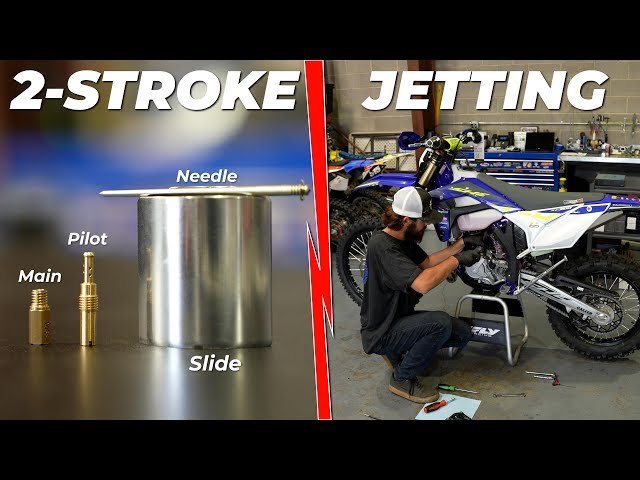
Carburetors mix fuel with incoming air through three distinct, overlapping internal circuits. The pilot jet controls fuel from idle to about one-quarter throttle opening. The jet needle and its clip position meter fuel from one-quarter to three-quarters throttle, which is where riders spend most of their trail time. The main jet controls fuel delivery from three-quarters to wide-open throttle.
Many people believe adjusting the air screw on the outside fixes a flat mid-range or an engine that cuts out at high speed. The air screw only fine-tunes the idle and off-idle pilot circuit. Brass jets have fixed internal holes measured in hundredths of a millimeter; fuel gets drawn up through these holes by low pressure created when air rushes through the carburetor venturi.
The basic method
Warm your dirt bike to full running temperature for five minutes before making any changes.
- Turn your air screw fully in until it lightly seats, then back it out 1.5 turns to establish your baseline starting point.
- Start the engine and turn the air screw in quarter-turn steps: if the idle peaks at less than 1 turn out, install one size smaller pilot jet; if it peaks at more than 2.5 turns out, install one size larger pilot jet.
- Loosen the front and rear intake clamps with an 8 mm socket, twist the carburetor body sideways, and remove the bottom 17 mm drain plug.
- Unscrew the brass main jet using a flat-head screwdriver, swap it by one size (typically increments of 2.5 or 5), and tighten it until snug.
- Remove the carburetor top cap with a Phillips screwdriver, pull the slide assembly out, compress the return spring, and unhook the throttle cable.
- Use needle-nose pliers to remove the jet needle, move the small E-clip up by one slot to make the mid-range leaner, or down by one slot to make it richer, then reassemble the slide.
- Test the bike in third gear on a flat stretch of dirt to verify throttle response across all ranges.
The critical judgment call is diagnosing hesitation: a sharp “bwwaaah” bog means the mixture has too much air (lean), while a dull, sputtering “four-stroke” sound means it has too much fuel (rich). Working around spilled gasoline carries an immediate fire hazard; keep an approved fire extinguisher nearby and work outdoors.
Key numbers and settings at a glance
Carburetor tuning depends directly on elevation and ambient air temperature.
What separates good results from bad ones
Clean Mechanical Preparation
Skilled mechanics never touch a carburetor jet until they confirm three other systems are perfect. The engine must have good mechanical compression, fresh fuel mixed at the proper oil ratio, and an undamaged spark plug. Installing richer jets to fix an air leak around cracked intake boot rubber ruins engine tuning. A clogged air filter also restricts airflow and makes the bike act rich, so clean and oil your filter before you touch any brass.
Isolating Individual Throttle Positions
Good tuners change only one brass component at a time, followed by a targeted test ride. If you change the needle clip and the main jet at the exact same moment, you won’t know which part fixed your problem or made it worse. Conduct a wide-open throttle cut to read the main jet properly: run wide open in fourth gear under load, pull the clutch, hit the kill switch instantly, coast to a stop, and check the spark plug color.
Common problems and quick fixes
Reading engine feedback helps you pick the right fix without guessing.
| What you notice | What it usually means | What to do first |
|---|---|---|
| Engine revs hang high after releasing throttle | Air leak or lean pilot circuit | Turn air screw in 1/2 turn |
| Bike stalls immediately when opening throttle | Clogged pilot jet passage | Spray pilot jet clean with carb cleaner |
| Loud sputtering at half throttle | Jet needle setting is too rich | Raise clip position by 1 groove |
| Engine knocks under heavy uphill pull | Main jet is too lean | Install 1 size larger main jet |
Environmental Rules and Tampering Limits
Carburetor settings must follow off-highway vehicle noise and tailpipe emissions guidelines. The EPA Nonroad Engines regulations set clear emissions benchmarks that prohibit altering fuel metering systems to run excessively rich on public lands. Running too rich discharges unburned two-stroke oil and raw gas directly out of your silencer into public waterways and soil.
If your carburetor fuel passages are corroded by degraded ethanol, ultrasonic cleaning requires specialized tank equipment. Take heavily gummed carburetors to an authorized power-sports technician rather than drilling out small brass passages at home.
Carburetor Maintenance Between Rides
Once your bike runs cleanly, record your temperature, elevation, and final jet sizes in a small notebook inside your toolbox. Two-stroke carburetors hold a small pool of premix fuel that evaporates quickly when stored. If your dirt bike sits unused for more than three weeks, turn the petcock valve off and loosen the float bowl drain bolt to purge remaining premix.
Leaving premix fuel inside the bowl leaves sticky two-stroke oil residue that plugs tiny pilot jets. You’ll know service is due when the bike requires full choke to start even on warm days.
When to use a different approach
Jetting changes won’t fix every engine performance problem. If your dirt bike has modern electronic fuel injection, you must remap fuel trims using a plug-in electronic control module tuner rather than swapping brass jets.
This mechanical process is also not for worn-out engines. If your cylinder has low compression or cracked reed valves, adjusting carburetor brass only masks the real mechanical damage. Replace worn piston rings, worn reed petals, and dried crank seals before attempting to tune fuel delivery.
Frequently asked questions
Can bad jetting destroy my 2 stroke dirt bike engine?
Yes, running your engine too lean can destroy it within minutes. A lean fuel mixture generates excessive combustion chamber heat and provides insufficient lubricating oil, causing the piston to expand rapidly, scuff the cylinder wall, and seize.
Why does my dirt bike run worse in the mountains?
Air pressure drops at high altitudes, which means every cubic foot of air contains fewer oxygen molecules. Because your carburetor still pulls the same volume of liquid gasoline through its jets, the fuel-to-oxygen ratio becomes far too rich.
How long does a carburetor jet last before wearing out?
Carburetor jets last for hundreds of engine hours because they have no moving parts. However, they need immediate replacement if scraped with metal wire, stripped by an incorrect screwdriver, or corroded by acidic, degraded ethanol fuel.
Is it safe to clean clogged jets with safety wire?
No, using hard steel wire or drill bits to clean brass jets is unsafe. Brass is soft, so wire quickly scratches or enlarges the precisely calibrated fuel orifice, permanently altering fuel flow and ruining your jetting setup.
What happens if I move the needle clip down?
Moving the needle clip down raises the tapered jet needle higher out of the needle jet. This opens the fuel passage sooner, allowing more gasoline to enter the engine from one-quarter to three-quarters throttle.
Final Thoughts
Once your bike runs crisp across the entire throttle range, keep a small notebook in your gear bag to track the settings that work best in different temperatures. You’ll find that small tweaks become second nature over time, so don’t be afraid to experiment when the seasons change and the air gets thinner.