
Choosing the right water filter pitcher comes down to your specific water quality concerns and how much maintenance you’re willing to do. While all these pitchers improve taste, they differ significantly in their ability to remove heavy metals, bacteria, and dissolved solids.
As an Amazon Associate, we earn from qualifying purchases. This post contains affiliate links – if you buy through them, we may earn a commission at no extra cost to you.
Best overall: Brita Large 10 Cup is a reliable choice for daily use, fitting easily in most fridges while reducing chlorine, mercury, and copper for better-tasting tap water. Most thorough filtration: ZeroWater 10-Cup Pitcher includes a meter to test dissolved solids, ensuring you know exactly when the 5-stage filter needs replacing for the purest output. Best for heavy contaminants: Clearly Filtered Pitcher uses advanced technology to target hundreds of contaminants, including fluoride and microplastics, without removing the beneficial minerals your body needs.
This guide is for anyone looking to improve their tap water quality without installing permanent under-sink systems.
How We Picked
We compared 48 different water filter pitcher listings currently available on Amazon to identify the most reliable options. To earn a spot in this article, a product had to clearly state its filtration certifications, provide specific capacity figures, and define its filter replacement lifespan. We excluded any models that lacked detailed material information or clear guidance on what specific contaminants they reduce. Each pick is judged based on the features listed by the manufacturer, focusing on build quality, filter performance, and ease of use.
1. Brita Large 10 Cup Water Filter Pitcher
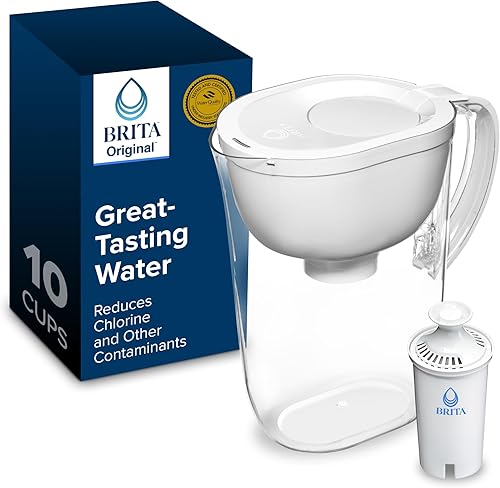
Best for: Households needing a standard, reliable daily filter.
This pitcher holds 10 cups of water, enough to fill three 24-ounce bottles. Its space-efficient design measures 10.47 inches tall and 5.59 inches wide, fitting most refrigerator shelves. The locking lid ensures you can pour without spills.
If you prioritize taste, this unit reduces chlorine, mercury, copper, zinc, and cadmium. Use the Standard filter and replace it every 40 gallons or approximately every 2 months. If you prefer convenience, the Longlast filter lasts 120 gallons or roughly six months.
Most users mistake these filters for universal solutions. They don’t remove total dissolved solids or fluoride. If your local water report lists these specific contaminants, this pitcher won’t provide the purification you need.
Pros
- Fits easily in refrigerator.
- Reduces chlorine, mercury, copper.
- Easy-fill locking lid.
Cons
- Doesn’t reduce TDS.
- Filter life varies by model.
2. ZeroWater 10-Cup Pitcher Water Filter Removes PFOA/PFAS

Best for: Users who want to track their water purity.
This system is unique because it includes a dedicated TDS meter. You use this tool to check the levels of dissolved solids like metals, salts, and ions before pouring. If the meter shows a reading above zero, you know immediately that it’s time to change your filter.
The 5-stage ion exchange process removes virtually all dissolved solids. This creates the purest tasting water, but it also strips out minerals. If you prefer mineral-rich water, this intensive filtration system isn’t for you.
You can save up to 110 single-use plastic bottles per filter, or 660 bottles annually. The system is IAPMO certified to reduce PFOA/PFOS, lead, chromium, and mercury.
Pros
- Includes a TDS testing meter for real-time monitoring.
- Removes virtually all dissolved solids.
- IAPMO certified for lead and other contaminants.
- BPA-free construction.
Cons
- Intensive filtration removes beneficial minerals.
- Requires consistent meter checks to ensure filter effectiveness.
3. Waterdrop PT-07B Water Filter Pitcher

Best for: Apartment dwellers with limited fridge space.
The compact 10″ x 5″ x 10.1″ design makes this pitcher ideal for small kitchens, dorms, and offices. It features a hands-free lid that opens automatically when you pour, which keeps dust out and makes the process more hygienic.
This pitcher is perfect for someone who wants a simple, effective way to improve their daily drinking water. It isn’t for those looking to lower the TDS value of their water, as the manufacturer explicitly states that its filtration focus is on chlorine, odor, and metal ions. If you prioritize low TDS, choose the PT-13W model instead.
Check your fridge dimensions before ordering to ensure the unit fits. You must use the PF-01A filter for a proper seal; using off-brand alternatives compromises the NSF/ANSI 42 and 372 certified performance. The LED indicator tracks your usage, but plan to replace the filter every 200 gallons or 3 months to maintain flow.
Pros
- Compact, space-saving design.
- Automatic hands-free lid.
- LED filter replacement indicator.
Cons
- Doesn’t lower TDS.
- Requires specific PF-01A filter model.
4. Waterdrop WFD-40L Water Filter Dispenser

Best for: Large families needing high water volume.
With a 35-cup capacity, this dispenser is built for heavy daily use. It uses carbon fiber filtration to achieve a fast flow rate, meaning you can filter a full tank in just five minutes. Use this if your household consumes water quickly, as the 200-gallon filter lifespan lasts five times longer than most competing models.
This unit isn’t for users who prioritize low TDS values. If your primary goal is reducing total dissolved solids, choose the Waterdrop TDS Reduction Rechargeable Dispenser instead. Before buying, measure your refrigerator shelf against the 14.37 by 5.55 by 9.95-inch dimensions.
Pros
- Large 35-cup capacity.
- Very fast flow rate.
- Includes replacement indicator.
- NSF-certified carbon fiber filtration.
Cons
- Large footprint in fridge.
- Doesn’t lower TDS.
- Requires specific space clearance for the 14-inch length.
Check your fridge depth before purchase, as the unit’s size is significantly larger than standard pitchers. The sliding cover and bottom arc design help with daily handling.
5. Clearly Filtered Water Filter Pitcher

Best for: Health-conscious users targeting a wide range of contaminants.
This pitcher is built from medical-grade Tritan plastic and targets over 386 contaminants. It’s a robust option that removes things like fluoride, lead, and microplastics while leaving beneficial minerals in the water. Use this if you need to address specific threats like PFAS, arsenic, or pharmaceuticals.
It’s ideal for parents or anyone concerned about tap water quality. If you only need to improve the basic taste or chlorine levels, a standard pitcher will suffice. This is a premium product designed for those requiring maximum removal rates.
The 80-ounce capacity serves a family, but you must account for the 100-gallon filter lifespan. Expect to replace the filter every four months. If you notice the flow rate slowing significantly before that window, it’s time for a swap.
Pros
- Targets 386+ contaminants.
- Preserves beneficial minerals.
- Medical-grade BPA-free plastic.
Cons
- Requires careful lid handling.
- Higher volume of filtration.
6. Waterdrop PT-72W Glass Water Filter Pitcher

Best for: Those who prefer glass over plastic.
This pitcher uses a high-quality glass construction, providing an eco-friendly alternative to standard plastic containers. While the design includes a sturdy plastic inner liner for added durability, the primary exterior is glass, making it easy to clean and maintain.
It’s a great fit for users who want to avoid plastic contact with their drinking water. However, this isn’t for people who want a dishwasher-safe pitcher, as the glass material requires careful hand-washing to prevent damage.
If you’re looking to lower your water’s TDS value, this model isn’t the right choice; you should instead choose the PT-13W pitcher. Always check your model number before ordering replacements, and use only genuine PF01A-P filters to ensure a precise fit.
Pros
- High-quality glass construction.
- Fast 8.5 oz/min flow.
- Certified for mercury reduction.
Cons
- Not dishwasher safe.
- Holds only 7 cups.
- Doesn’t reduce TDS.
7. PUR 11-Cup Water Pitcher
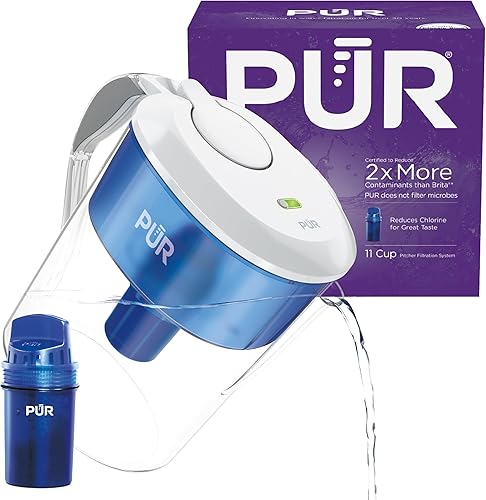
Best for: Users who value an ergonomic design.
The PUR pitcher features a stay-tight lid, allowing you to pour water while the reservoir is still filtering. The handle is built for comfort, making it easy to lift even when the 11-cup vessel is full. Because all components are dishwasher-safe, maintenance is simple.
If you prioritize speed, this model offers faster filtration than the PUR Plus Pitcher. However, ensure you use only genuine PUR filters. While third-party options may fit, they aren’t certified to reduce the 15 chemical and physical substances, such as mercury, copper, and zinc, that the official filter targets.
Replace your filter every 40 gallons or every two months to maintain performance. If your water usage is high, track your volume to avoid exceeding the 40-gallon limit before the two-month mark. This remains a practical choice for reducing single-use plastic waste while improving tap water taste through IAPMO-certified filtration.
Pros
- Comfortable, ergonomic handle.
- Stay-tight pouring lid.
- Dishwasher-safe components.
Cons
- Limited to 15 substances.
- Filter life is modest.
8. LifeStraw Home Essential BPA-Free Water Filter Pitcher

This pitcher removes microplastics, bacteria, and parasites, while the other models listed do not. It also reduces PFAS, lead, mercury, chlorine, herbicides, pesticides, VOCs, dirt, sand, and cloudiness. Its one-piece welded construction ensures zero leakage and maximum durability for everyday use.
If you’re concerned about the biological safety of your water, this is your primary choice. If you prioritize a simple filter, look elsewhere. The complexity required to remove parasites and bacteria increases the maintenance needs compared to standard carbon-only pitchers.
The unit features a Danish-inspired design with an ergonomic handle and an easy-fill lid. It’s sized to fit standard refrigerator doors and shelves with ease. Use this pitcher if your water source has known microbiological threats or heavy sediment. If your water is already treated and safe, the extra filtration layers may represent an unnecessary expense and higher upkeep.
Pros
- Removes bacteria and parasites.
- Durable, leak-free construction.
- Reduces microplastics and PFAS.
Cons
- Requires more filter maintenance.
- Heavier than basic pitchers.
9. Epic Nano XP Water Filter Pitcher

Best for: Those needing powerful nano-filtration.
The Nano XP filter uses dual-layer pleated media to capture a wide range of contaminants, including viruses, bacteria, cysts, lead, and PFAS. This design doubles the surface area, resulting in a flow rate 30% faster than previous models.
This is the right choice if you rely on well water or have specific concerns about municipal tap water. However, if your primary goal is fluoride reduction, choose the Epic Pure XP model instead; the Nano XP is engineered to leave naturally occurring fluoride in your water.
Each filter lasts for 100 gallons, or roughly three to four months of regular use. To reduce waste, swap only the internal cartridge while keeping the housing, which cuts plastic waste by up to 75%. For the best results, always wait for the water to fully filter into the bottom reservoir before pouring. Keep a steady hand on the lid during use to ensure it stays in place.
10. Amazon Basics 10-Cup Water Filter Pitcher Compatible with Brita Filters

Best for: Users who want simple operation and a straightforward design.
This is a straightforward, no-frills pitcher that gets the job done for everyday hydration. It’s compatible with standard Brita filters, giving you plenty of options for replacements. The compact design fits easily on refrigerator shelves, keeping water cold without consuming excessive space.
The secure lid technology prevents leaks during pouring, allowing you to use the unit as a countertop dispenser. You should choose this model if you primarily want to reduce chlorine taste and odor. However, if you require protection against heavy metals like mercury or cadmium, rely on its WQA certification against NSF 53 standards.
The generous reservoir fills three 24-ounce bottles before needing a refill. Remember that each filter lasts up to 40 gallons. If you notice a drop in flow, replace the steam-treated filter immediately to maintain water quality. This unit is ideal for students or anyone needing a functional, BPA-free solution for daily water consumption.
How to Choose in Sixty Seconds
Which filter type do I actually need?
The most important factor is identifying what you want to remove. If your only concern is the taste and smell of chlorine, a standard carbon filter like those found in the Brita Large Pitcher is sufficient. However, if you’re worried about lead, PFAS, or bacteria, you need a system with higher-level certifications, such as the Clearly Filtered Pitcher or LifeStraw Home Essential.
Always check the NSF certification labels on the product to confirm it addresses the specific contaminants you’re concerned about. If you prioritize low Total Dissolved Solids (TDS) values, choose a system like the ZeroWater Pitcher. If you prefer to keep naturally occurring fluoride in your water, look for models like the Epic Nano XP.
Does the pitcher size really matter?
Yes, the size impacts how often you have to refill it and how much space it takes up in your fridge. This standard pitcher size fits most shelves, but if you have a large family, you might find yourself refilling it constantly. In that case, a larger unit like the Waterdrop WFD-40L Dispenser, which holds 35 cups, is better. Before you order, take a quick measurement of your refrigerator shelf height and width to ensure the unit will fit comfortably and leave enough room for your other groceries.
How do I know when the filter is done?
Most modern pitchers, like the Waterdrop PT-07B, include an indicator light or a digital display to track filter life. If your model lacks this, you should keep a calendar or a note on your phone to track the time.
Filters must be replaced according to the manufacturer’s schedule to maintain performance. If you’re using a ZeroWater pitcher, use the provided TDS meter to check the levels of dissolved solids before pouring; if the reading rises, it’s time to change your filter.
Related guides
Frequently Asked Questions
What does the pitcher have to work with?
Most pitchers use activated carbon and ion exchange to remove chlorine, odors, and heavy metals from treated municipal tap water. If your water has high sediment levels, the filter may clog faster than estimated. Check if your local water contains fluoride, as some filters remove it while others do not.
What does owning it ask of the buyer afterwards?
Owning a filter pitcher requires a commitment to regular filter changes and basic cleaning of the reservoir. Most manufacturers recommend replacing the filter every two to six months, depending on your usage and local water quality.
What goes wrong first?
The most common issue is the filter clogging, which significantly slows down the flow rate and can make the water taste stale. If you notice the water flow slowing to a crawl, it’s almost always a sign that the filter is saturated and needs to be replaced immediately to ensure proper filtration.
Is the simplest one on the list enough?
A basic pitcher is often sufficient for improving the taste of tap water if your supply is already safe. These models effectively remove the harsh taste of chlorine without the need for advanced microbiological filtration. If you have specific health concerns or local water quality issues, prioritize advanced filtration systems instead.
Conclusion
Once you’ve identified your primary water concerns, check your local utility’s annual report to see what’s actually in your pipes. It’s a simple way to ensure you aren’t paying for extra filtration you don’t really need. You’ll feel much better knowing your glass is filled with exactly what you want.