
As an Amazon Associate, we earn from qualifying purchases. This post contains affiliate links – if you buy through them, we may earn a commission at no extra cost to you.
You’re choosing between different ways to manage extreme heat under your hood, ranging from flexible wraps for pipes to protective sleeves for delicate wires and hoses. The main difference lies in how you install them and whether they’re meant to shield a pipe or protect a sensitive line.
Best overall: LEDAUT Titanium Exhaust Wrap offers high heat resistance and includes stainless ties for secure attachment. Best for wiring: Golden Aluminized Heat Shroud uses a hook and loop design for easy wire protection. Best for coverage: Peastorm Aluminum Heat Shield provides a wide, flat surface that’s easily cut to fit.
The rest of this guide is for anyone looking to protect their engine bay components from thermal damage.
Comparison Table
1. LEDAUT 2″ x 50′ Titanium Exhaust Heat Wrap Roll

Best for: Exhaust pipes and headers on cars or motorcycles.
This wrap is made from titanium-based material that handles high temperatures while resisting vibration and oil. You must soak it in water before wrapping to keep the fibers from flying, and wearing gloves is necessary to prevent skin irritation.
The kit provides 50 feet of material and 16 stainless steel ties, which is enough to cover long exhaust runs. It isn’t designed for someone who wants a permanent, rigid shield, as this wrap requires careful winding and overlapping to stay in place.
Pros
- Withstands 1800F direct heat
- Includes stainless steel ties
- Resists oil and abrasions
Cons
- Requires soaking during installation
- Can cause skin itching
2. Design Engineering Heat Sheath Aluminized Sleeving

Best for: Protecting fuel lines and wiring from heat damage.
This sleeving uses 19 oz fiberglass insulation with an aluminized outer layer to reflect heat. It’s a slip-on product, meaning you must disconnect the hose or wire to slide the sleeve over it for a secure fit.
It’s built for heavy-duty use in industrial or automotive settings where chemicals and road grime are common.
Pros
- Reflects radiant heat up to 2000°F
- Shields against oil and chemicals
- Heavy-duty fiberglass construction
Cons
- Requires line disconnection for installation
3. Peastorm Exhaust Wrap Heat Shield Automotive Aluminum Material Muffler Wrap

Best for: Flat surfaces like engine compartments or mufflers.
This matting is 1/2 inch thick and features embossed aluminum bonded to glass fiber. It’s easy to cut with standard tools, making it versatile for protecting batteries, fuel tanks, or chassis sections from high heat.
The shield can handle continuous temperatures up to 1000°F.
Pros
- Easy to cut and shape
- Withstands 1000°F continuous heat
- Includes two stainless ties
Cons
- Sharp edges require caution
- Not for tight piping
4. Basalt Fiber Exhaust Wrap

Best for: Headers and manifolds with complex bends.
Made from basalt fiber, this wrap is designed to be pliable enough to conform to irregular pipe shapes. It creates a thermal barrier that protects nearby engine parts from radiant heat while maintaining flexibility through many heat cycles.
The kit comes with a 4-inch wide roll and 20 stainless steel ties.
Pros
- Highly flexible for curves
- Resists automotive fluids
- Includes 20 metal ties
Cons
- Requires careful overlapping
5. Heat Shroud Sleeving Exhaust Heat Shield 1.1”I.D. x 10FT Fuel

Best for: Wires and cables that are already connected.
This shroud features a hook and loop closure that lets you wrap cables and hoses without removing them from the vehicle. It uses glass fiber fabric and an aluminized layer to handle both direct and radiant heat.
The package includes 10 metal zip ties and a pair of gloves. It isn’t intended for high-pressure exhaust contact, as it’s rated for 600 degrees F of direct heat rather than the extreme temperatures found directly on an exhaust manifold.
Pros
- Easy hook and loop closure
- No need to disconnect wires
- Includes gloves and ties
Cons
- Not for direct exhaust flames
6. Titanium Pipe Shield
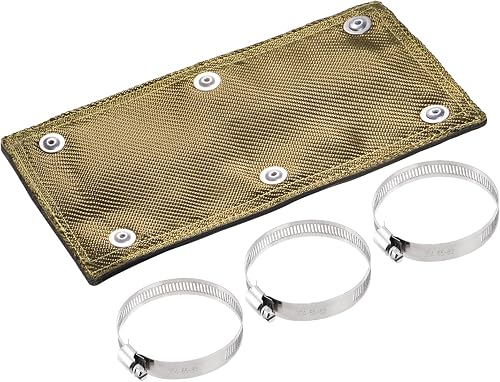
Best for: Rigid mounting on exhaust pipes.
This shield uses a double-layer design with titanium on the outside and silica fabric on the inside. It includes a bracket system that creates an air gap between the shield and the pipe, which helps with cooling.
Installation is simple thanks to the included hose clamps. It isn’t the best choice if you need to cover a very long section of pipe, as this shield is limited to a 6-inch by 12-inch size.
Pros
- Creates a cooling air gap
- Rated for 1350°F
- Easy rivet-based installation
Cons
- Limited surface area
7. SunplusTrade 2″ x 50′ Black Exhaust Heat Wrap Roll

Best for: Users who prefer a black aesthetic.
This fiberglass wrap provides a dark finish while managing under-hood temperatures. It’s resistant to abrasions and vibration, making it a standard choice for performance motorcycles and car exhausts.
The kit includes six stainless steel locking ties.
Pros
- Clean black finish
- Resists oil and vibration
- Universal fitment
Cons
- Lower heat rating than titanium options
8. Hook and Loop Heat Shroud

Best for: Quick, tool-free wire protection.
This shroud uses an aluminized surface and a hook and loop design to protect hoses and cables. It’s very pliable, which helps when routing it through tight spaces in an engine bay.
It’s designed for temperatures up to 160°C. It isn’t meant for direct contact with exhaust flames or red-hot surfaces, so keep it away from the hottest parts of your engine.
Pros
- Very pliable for tight bends
- Easy to trim to length
- Convenient hook and loop closure
Cons
- Not for direct exhaust contact
How to Choose in Sixty Seconds
Does material type matter?
Titanium and basalt wraps are rated for higher temperatures than standard fiberglass, making them suitable for headers.
Which installation method is easiest?
If you can’t disconnect your hoses or wires, choose a shroud with a hook and loop closure. These allow you to wrap the component without taking anything apart. For exhaust pipes, look for wraps that include high-quality stainless steel ties, which are essential for keeping the material secure during vibration.
Should I worry about safety?
Always handle fiberglass wraps with gloves to prevent skin irritation. When working with heat protection, follow the Occupational Safety and Health Administration guidelines for handling synthetic mineral fibers. Ensure your chosen product is rated for the specific type of heat—direct or radiant—that it will face in your engine bay.
Closing
The LEDAUT Titanium Exhaust Wrap is our top pick for its overall durability and high-temperature capability, while the Golden Aluminized Heat Shroud is the best choice for protecting sensitive wiring without needing to disconnect lines. Check your engine bay clearances and pipe sizes before placing your order to ensure the best fit.
Frequently Asked Questions
Can I use these wraps on my intake system?
Yes, but they’re usually overkill for intakes. These products are designed for high-heat exhaust components. If you use them on an intake, they will reflect heat, but they’re often thicker than necessary. Ensure the material doesn’t restrict airflow or interfere with any sensors near your air intake.
How do I know if I need a wrap or a shield?
Wraps are best for pipes with complex bends where you need to conform the material to the shape. Rigid shields are better for flat surfaces or when you want to create an air gap to help with heat dissipation. Choose a wrap for headers and a shield for mufflers.
Will these products stop a leak?
No, these are for heat management only. If you have a leaking line, replace the hose or wire completely before adding any heat protection. These products are purely for shielding against external heat sources.
What happens if the wrap gets wet?
Most of these materials are resistant to oil and water, but they can hold moisture if they aren’t installed tightly. Ensure your wrap is tight and that your exhaust system is properly sealed to prevent water from soaking into the fibers.
Final Thoughts
Once you’ve decided which parts need the most protection, take a quick look at your engine bay to see where the tightest spots are. Don’t rush the process; you’ll find that taking your time ensures a clean, secure fit that keeps your vehicle running smoothly for many miles to come.